Showing posts with label Civil Liberties. Show all posts

Tuesday, December 18, 2012

Pepper Spray


Israeli border police officers use pepper spray as they detain an injured Palestinian protester during clashes on Land Day after Friday prayers outside Damascus Gate in Jerusalem's Old City, March 30, 2012. Israeli security forces fired rubber bullets, tear gas and stun grenades to break up groups of Palestinian stone-throwers as annual Land Day rallies turned violent. Police said they made five arrests at Damascus Gate. Land Day commemorates the killing by security forces of six Arabs in 1976 during protests against government plans to confiscate land in northern Israel's Galilee region (Ammar Awad/Reuters via Big Picture).

Saturday, February 4, 2012

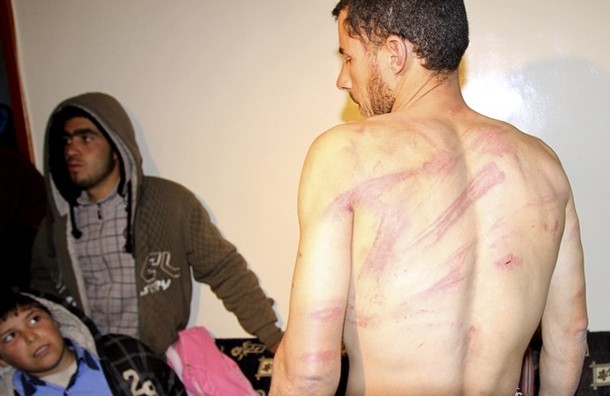
A Lebanese Fisherman in Syria

A Lebanese fisherman shows the marks on his back after he was arrested by Syrian forces with his nephew Maher Hamad in Arida town in northern Lebanon January 22, 2012. Syrian forces killed a Lebanese fisherman and wounded another when they seized a boat suspected of smuggling off the Lebanese-Syrian coast on Saturday (Reuters Pictures via Daylife).

Wednesday, August 3, 2011

BBCNews Update Video Brutal Crackdown in Syria

Rape of Men - A Weapon of War

Time Magazine's Global Spin blog writes:

In Kampala, Uganda, he meets a refugee who was kidnapped and then raped three times a day, every day, for three years. "There are certain things you just don't believe can happen to a man," he said.

Tuesday, May 24, 2011

Video: Israeli Police Commander Slaps Female Lawyer

Kobi Bachar, deputy commander of the Galilee District Police, slaps an Arab lawyer after she asks him why he's arresting protesters.

Wednesday, May 11, 2011

US Senator Cardin on Syria Human Rights Resolution

Syrian Regime Using Torture as Primary Weapon

Activists of the international non-governmental organization 'Reporters sans frontieres' (Reporters without borders) based in France demonstrate on May 3, 2011 in front of the Syrian Embassy after splattering the facade with ink in Paris to protest against attacks on journalists in Syria as part of World Press Freedom Day. Grafitti on wall reads: 'Ink must flow not blood.' (Getty Images via Daylife).


The UK's Telegraph reports:
Photographic evidence collected by Western and local rights agencies indicate that children as young as 12 have faced heavy beatings at the hands of Mr Assad's feared secret police, the Mukhabarat. Men and women were said to suffer even more extreme punishment, ranging from electric shocks to the extraction of fingernails.

As Syria braces for an eighth consecutive weekly showdown between the security forces and demonstrators after midday prayers on Friday, graphic testimony is slowly emerging of the price paid for challenging Mr Assad's 11 year-rule.

Unable to quell the unrest through force alone, despite having killed hundreds of civilians, Syria's security forces have instead resorted to mass intimidation. Over the past week, the number of detentions has soared to more than 500 a day, bringing the total to more than 8,000.

With prisons filled to capacity, many of those detained are being transported by bus into schools that have been transformed into makeshift "concentration camps", according to the National Initiative for Change, a newly-formed Syrian opposition coalition.

Inmates who have been released in recent days said they were held in locked classrooms where they were so tightly-packed there was only room to stand. Many were taken down to the cellars where the Mukhabarat has set up instruments of torture.

"They suspended me in the air from my wrists," one protester said in emailed comments. "They demanded that I confess to working for the Mossad, or for the Saudis or for the Lebanese and when I refused they shocked me with a cable whose wires were sticking out."

Some inmates, according to testimonies collected by rights groups, had their finger nails pulled out, their toes smashed with hammers or their tongues squeezed and pulled with pliers.

Deprived of water for days at a time, many inmates were allegedly reduced to drinking from lavatory bowls.

The vast majority of detainees are usually released within three days, a deliberate tactic, opposition activists say.

"They torture them brutally and then release them into the community as messengers of fear," said Ausama Monajed. "But it is not working. It only fuels anger and makes the people more determined.

Ban Ki-Moon, the UN secretary general, telephoned Mr Assad yesterday to protest "the possible violation of human rights" in Syria.

His call came as the Syrian army announced it was pulling out of Deraa, the southern city that has seen some of the worst bloodshed during a week-long siege where snipers frequently shot at anyone leaving their homes.
...

Friday, April 29, 2011

Documentary Video: Maid in Lebanon II


The documentary's creators describe it as follows:
This documentary explores the complexity of the relationship between migrant domestic workers and the Lebanese households as employers in an honest, and at times humorous and touching manner.

This documentary chronicles the life of migrant women workers in Lebanon: their joys, pains, expectations, struggles and finally their humanity.

"Maid in Lebanon II: Voices from Home" poses questions and suggests answers in workers' rights, employment contracts and everyday terms and conditions of work. It emphasizes the importance of improving cross-cultural understanding and encouraging better working relationships.

Shot on location in Lebanon and Sri Lanka.
Related Posts:

Tuesday, April 26, 2011

Easter Weekend Massacre: Enforced Disappearance in Syria

At least 221 Syrians have gone missing in the past three days of the violent crackdown on pro-democracy protests, said Insan, a Syrian human rights organisation, with many feared forcibly disappeared.

Working with a team of human rights researchers inside Syria, Insan said it had documented the names of 221 Syrians missing since the early hours of Friday morning, none of whom the authorities had acknowledged holding in detention.

"We are not counting people who we know have been detained. We are strictly talking here about people whose families do not know if they are dead or alive. People who have disappeared," said Wissam Tarif, executive director of Insan.

The rights group and its network inside Syria had spoken to close family members of all 221 missing persons, said Tarif, and while some had yet to make contact with the security services, most families had been told by authorities that their relative was not being held.

'Abused, beaten, detained'

"Family members have been shouted at, abused, beaten and even detained when asking at political security branches for the whereabouts of their relatives," said Tarif.

Under the terms of an international treaty, enforced disappearance is defined as the arrest, detention or abduction of a person by the state or agents of the state followed by the refusal of authorities to acknowledge the whereabouts of the missing person, thus placing them outside the protection of the law.

Enforced disappearance is a crime against international law, according to Amnesty International, the London-based human rights watchdog.

"The circumstances of each disappearance vary," said Insan. "Many were kidnapped from the streets after or during anti-government demonstrations. Others were kidnapped from the streets of their neighborhoods by security forces or by members of the recently established local Baath Party community watch."
...
"We expect that some of the people on the list are dead. We know there are bodies being held in Tishreen military hospital and in the military hospital in Aleppo," said Tarif of Insan.

The majority of the missing people disappeared during the wave of protests across towns nearby the capital and its suburbs, while some 68 people went missing in the central city of Homs alone. A further 41 people have disappeared from Daraa and its surrounding villages.

In a meeting last month the UN Working Group on Enforced or Involuntary Disappearance discussed the case of thousands of Syrians who vanished during the rule of late Syrian president, Hafez al-Assad.

In a written statement to the UN Human Rights Council, Radwan Ziadeh, head of the Damascus Centre for Human Rights Studies, put the number of Syrians who disappeared between 1980 and 1987 at some 17,000.

Thursday, April 21, 2011

Video: BBC Panorama - A Walk in the Park

Panaroma BBC A Walk in the Park Part 1 by haaktar


I couldn't find Part 2 but Part 3 can be viewed here.  The program site can be accessed here, where you'll be able to find some clips and further research material.  An audio slideshow of the program is also available.

Monday, April 18, 2011

Turkey Jails More Journalists Than Any Other Country

Journalists and activists participate in a rally calling for press freedom in central Ankara 19 March, 2011. The recent arrest and jailing of journalists as part of investigations into Ergenekon, an alleged ultra-nationalist, secularist network opposed to Prime Minister Erdogan's rule, has triggered expressions of concern from the European Union, the United States and human rights groups about Ankara's commitment to media freedom and democratic principles (Reuters - Umit Bektas).

Press release from the International Press Institute:
The International Press Institute (IPI) today obtained a report from the Organization for Security and Co-operation in Europe (OSCE) indicating that Turkey is currently holding at least 57 journalists in prison – apparently more than any other country.
...
While Iran and China topped lists last December by reportedly jailing some 34 journalists each, Turkey, a candidate for membership in the European Union, has nearly doubled that number five months later, raising questions about the country’s commitment to freedom of the press and the legitimacy of its democratic image.
...
Estimating that there are between 700 and 1,000 ongoing proceedings that could result in imprisonment of journalists, Mijatović said: “The sheer number of cases poses fundamental questions about the legal provisions governing journalism in Turkey, and it raises concerns that the number of journalists in prison can further increase.”
...
According to the report, another 10 journalists in Turkey are awaiting trial. An additional journalist, whose location is unknown, is subject to a search warrant, and two other journalists have been convicted but subsequently released.

The report found that most of the jailed journalists are imprisoned under articles of Turkey’s anti-terror law relating to criminal code provisions on terrorist offences and organizations, or assisting members of or making propaganda in connection with such organizations; or under criminal code prohibitions on establishing, commanding or becoming member of an armed organization with the aim of committing certain offences.

It also found that prosecutors have sought and courts have imposed extremely long sentences. Vedat Kurşun and Emine Demir of the Azadiya Welat newspaper were sentenced to 166 years and 138 years in prison, respectively, while Bayram Namaz and Ibrahim Çiçek of the Atilim newspaper each face up to 3,000 years in prison. Mustafa Balbay of Cumhuriyet newspaper, Mehmet Haberal of Kanal B Television and Tuncay Özkan of Kanal Biz Television all face dual life sentences, plus further time.

Journalists also face several trials, the report noted, such as Halit Güdenoğlu of Halit Yürüyüş magazine, who currently faces 150 court cases.

The OSCE said in a release accompanying the study that both laws and their implementation need to be reformed, insofar as court practices vary widely throughout the country. The group also noted that writing about sensitive issues, including issues of terrorism or anti-government activities, is often viewed as support for those activities, and that imprisoned journalists are often placed in high security prisons with the most dangerous criminals.

IPI Board Member Ferai Tinc, who is also chairperson of IPI’s Turkey National Committee, said: “These journalists are in jail because of Turkey’s anti terrorism law, which has become a law that threatens press freedom in Turkey. Every investigative journalist is threatened by this law. We find this unacceptable. We have asked the government to change this law, but, unfortunately, the government does not listen to the voices of professional journalism organizations.”

IPI Director Alison Bethel McKenzie added: “Turkey, at the crossroads between east and west, is a major regional power with an ancient cultural heritage. The country is also often held up as an example of a healthy Muslim democracy, and IPI held its high-profile annual World Congress in Istanbul in 2007 in recognition of the pivotal bridge-building role the country plays.
...
The OSCE noted in its report that in many cases it could not access full information, meaning details could not be stated with precision. The organisation also pointed out that in many cases classified as secret defence lawyers were not even given access to trial documents.

Saturday, April 16, 2011

HRW: Syrian Protesters Being Tortured


Human Rights Watch brings to light the brutality the Syrian regime seeks to practice in the darkness of its dungeons:
Syrian security and intelligence services have arbitrarily detained hundreds of protesters across the country, subjecting them to torture and ill-treatment, since anti-government demonstrations began in mid-March 2011, Human Rights Watch said today. The security and intelligence services, commonly referred to as mukhabarat, have also arrested lawyers, activists, and journalists who endorsed or promoted the protests, Human Rights Watch said.
...
"There can be no real reforms in Syria while security forces abuse people with impunity," said Joe Stork, deputy Middle East director at Human Rights Watch. ...

Human Rights Watch interviewed 19 people who had been detained in Daraa, Damascus, Douma, al-Tal, Homs, and Banyas, as well as several families of detainees. Those interviewed who had been detained included two women and three teenagers, ages 16 and 17. Human Rights Watch also collected information from Syrian activists about dozens of people detained in Daraa and Banyas, and reviewed the footage of some detainees released from Daraa, whose bodies appeared to have marks from torture. Those interviewed were held by various branches of mukhabarat, including state security (Amn al-Dawla), political security (Amn al-Siyasi), and military security (Amn al-Askari).

... In addition to the three children interviewed by Human Rights Watch, witnesses reported seeing children detained and beaten in the facilities where they were held.

Many told Human Rights Watch that they and other detainees were subjected to other forms of torture, including electro-shock devices, cables, and whips. Most also said they were held in overcrowded cells, and many were deprived of sleep, food, and water - in some cases, for several days. Some said they were blindfolded and handcuffed the entire time.

Most detainees interviewed by Human Rights Watch reported being forced to sign confessions without being allowed to read them, as well as pledges not to participate in future protests. Some also had to provide detailed personal information about themselves and their families, including family members' addresses and places of employment. None were allowed to have any contact with relatives or lawyers while in detention, and their families were not informed of their whereabouts.

... The number of people who remain in detention is impossible to verify, but several individuals told Human Rights Watch that a number of people from their communities who had been arrested during the protests had not returned and that their families had no information about their fate or whereabouts.

Beatings, Torture in Detention

Many of those interviewed shortly after their release still had traces of bruises on their faces and heads. One, a 17-year-old, could hardly move - he needed assistance sitting down and standing up. Human Rights Watch reviewed video footage showing evidence of severe beatings on the face and arms of another child, described in the footage as a 12-year-old from Douma, a town near Damascus.

A protester detained on March 25 ... said the security services beat him and put him in a bus with five or six other detainees and drove them to Damascus. He said he was first taken to the Palestine Branch of Military Intelligence and later to a branch of State Security on Baghdad Street:

[At State Security,] they lined us up in the corridor along the wall, and beat us. Then they dragged us to the basement - I lost consciousness for some time, they beat me very hard on my head. They first kept all 17 of us in one room, and took [us] out for interrogations from there - they beat us with a cable, and accused us of being Israeli and Lebanese spies. I was hooded at the time.

Another protester arrested during the same protest told Human Rights Watch that he was brutally beaten and tortured by three mukhabarat agencies: State Security, Political Security, and the Palestine Branch of Military Intelligence. He described his ill-treatment at the hands of Political Security, where he spent four days:

The security personnel took us out for interrogations in a room in front of the cell. We constantly heard the sounds of whipping and screams from that room. When they took me in, they put me face down on the floor, and started beating me with a cable on the soles of my feet, my legs and back. They were asking, "Why did you go to the demonstration? Who paid you to go? Who made you go?" They just wanted me to confess to something, did not matter what.

Another protester from al-Tal also reported that officers of the Palestine Branch of Military Intelligence used electric shock to torture him and others detained with him:

They beat us in the courtyard, and then took us into the basement. It was a big room, with about a hundred detainees in it, from different towns. They stripped us down to our underwear and poured cold water on us, beat us with cables, and shocked us with electric batons - those were cylindrical sticks that looked like a torch, they pressed them toward our arms and stomachs, each time for three to four seconds. The low-ranking soldiers did the beatings, and higher officers used the electro-shock devices. They were in uniforms, but without identifying signs.

A lawyer detained by State Security in Damascus told Human Rights Watch that he shared a cell with two detainees who were tortured with electro-shock devices, and another whose legs and feet were beaten so badly that he could not move. After one interrogation session, security personnel brought him back to the cell, hung him by his hands, and prohibited his cellmates from giving him food or water, or even talking to him. One detainee recalled a cellmate who had been beaten so badly on the soles of his feet that his toenails had fallen out. Another detained in a State Security facility in Damascus estimated that he heard approximately 30 people being beaten one Friday night after the security forces had brought in a new batch of protesters.
...
A 17-year-old detained in the coastal town of Banyas described his ordeal during his five-day detention at a local branch of Military Security:

... They kept us there with no food from Friday, when they arrested us, until Monday. ... I couldn't see anything. They beat me on my head, on my back, on my shoulders. They especially beat me on my face. With every word, they would beat me. ...

Two witnesses who were detained in a facility on Baghdad Street in Damascus reported hearing a woman scream as if in pain and cry in their facility, but they never saw her.

Forced Confessions

Most of those detained following protests told Human Rights Watch that they were forced to sign and put their fingerprints on papers without being allowed to read the document. A teenager from Douma detained for two days by the mukhabarat - he was blindfolded and so did not know which security branch - told Human Rights Watch:

I asked, "What is this paper?" and one of the security men grabbed my head, and pushed my mouth open, and the other one squeezed my tongue with something that felt like pliers and started pulling it. And when I refused to sign it, one of the interrogators took a hammer and started pounding on my toes. In the cell, they also beat me on the face with their Kalashnikovs [AK-47 assault rifles].
...
Activists and Journalists

Syria's security services have also arbitrarily arrested and tortured activists, writers, and journalists who have reported on or expressed support for the anti-government protests, detaining at least seven local and international journalists since protests began on March 16.
...
State Security also arrested one of the lawyers who represented the protesters detained at the March 16 demonstration calling for the release of political activists. He spent a week at the State Security detention facility in Damascus, where the security personnel on several occasions beat, threatened, and humiliated him. He spent most of his time handcuffed and hooded. ... The lawyer said that throughout his detention he heard sounds of beatings and screams of other detainees.

"By silencing those who write about events, Syrian authorities hope to hide their brutality," Stork said. "But their crackdown on journalists and activists only highlights their criminal behavior."

Detention Conditions

... One person detained at State Security in Damascus said he shared a 30-square meter cell with about 75 other people.

Several told Human Rights Watch that they were put in small solitary confinement cells about 1 by 1.5 meters - too small even to lie down. Officers sometimes forced two or even three detainees into these cells. One person detained in Damascus said that he shared a cell that was about half a meter by 1.75 meters with another person for four days. "When we slept we had to coordinate our movements to turn," he said. Another protester detained at a State Security facility on Bagdad Street in Damascus said that he shared a cell about three-quarters of a meter by 1.8 meters with two other men.
...
"Throwing peaceful protesters in dungeons, beating them, denying them access to the outside world, will only increase the chasm between Syria's rulers and its people," Stork said. "The terrible torture methods of the mukhabarat need to become a relic of the past."

Friday, April 15, 2011

Video: Al Jazeera English Report on Syria

The Bloody Damascus Spring

Dated April 12 2011, the video shows Syrian security forces beating bound men from the Banias town of Bayda in Syria.

An excellent article by The Economist summing up the situation in Syria ... the article pretty much in full below:
Syrian leaders are backing themselves into a corner by escalating a five-week-old standoff with protesters. At least 28 were killed across the country by security forces and thugs on April 8th. Four more were shot dead two days later in Banias after the army surrounded the coastal city and let loose the shabiha, a thuggish smuggling gang backed by the regime that has been responsible for violence elsewhere. Nearby villages including Bayda were raided. Human rights organisations say at least 100 residents were arrested in one day.

The government has signalled violence may increase further by issuing a warning that no tolerance or leniency will be shown. Apologist reports in state media are adding insult to injury.

Protesters see little chance of dialogue and are concluding that taking to the streets is their only option. Several hitherto peaceful cities have seen their first large demonstrations. Protesters’ numbers are growing and demonstrations that have routinely taken place after Friday prayers increasingly continue into the week. Groups of women, absent from many of the protests so far, went out to demand the release of detainees from Bayda.

Violence is also causing anger in quarters where the regime used to have at least some support. In recent weeks, a number of sheikhs from the religious establishment have given their blessing to protesters. Kurds, long repressed by the Arab majority, rejected a last-ditch offer of citizenship by government officials and took to the streets.

The army and intelligence services may be dominated by loyalists. But civilian elements of the elite are showing the first signs of fraying, both because they support reforms and out of growing discomfort at the security forces’ brutal and ham-fisted behaviour. Samira Masalma, editor of the state-run Tishreen newspaper, has been sacked after criticising shootings by armed units. Several of her relations are said to have been injured during protests in the city of Deraa. Several soldiers have been shot, some reportedly for refusing to fire on unarmed protesters.

All this has upped the ante for Syria’s president, Bashar Assad. He could have tried to quell demonstrations early on with sincere offers of reform, but he did not want to be seen as weak. Instead he opted for modest and unconvincing reform proposals. Tardy pledges to lift decades-old emergency laws and allow independent political parties have so far gone unfulfilled. ...

The government’s main focus in public pronouncements is to warn protesters against a collapse into sectarian strife. This resonates strongly with ordinary Syrians who have witnessed the recent sectarian conflicts in neighbouring Lebanon and Iraq. Still, Mr Assad’s scare tactics may not work.

Sectarianism has not been a big part of the protests. An open letter in al-Safir newspaper by leading artists stressed the importance of Syrian unity. Kurdish groups have been careful not to frame their grievances as a bid for autonomy or independence. Many protesters seem keen to emphasise the national nature of the demonstrations, chanting support for faraway cities on the receiving end of the government’s heavy-handed tactics.

As protesters become increasingly frustrated, their demands have grown. They now want not just the scrapping of emergency laws but the end of unchecked government powers, as well as true economic freedom and an end to corruption and elite privileges. From there it is only a small step to demanding the outright end of Mr Assad’s rule. Some have already taken it.
 Related Posts:

Thursday, April 14, 2011

Syrian Intelligence Memo (English Translated Version)

English translation is mine (feel free to send in corrections). Original Arabic version here (read it!!):
There is a growing trend in the low literacy segment of society to imitate what happened in Tunisia and Egypt by taking advantage of economic conditions in the country and the regional atmosphere which is conducive for popular movements.

It is necessary that we take advantage of past experiences in dealing with the hostile Muslim Brotherhood movement, and benefit from the mistakes of the Tunisian and Egyptian especially given that they had to neutralize the power of the army and Republican Guard from the outset and allowed the media to cover every move until events got out of control.

We don't expect things to progress to a point of serious danger to public order and the country or to threaten the continuity of the status quo. We expect things to continue for several months and after which it will die out and the regime will come out more powerful than ever.

The reduced security committee ... met on 23 3 2011 with regard to protests and demonstrations and it discussed all aspects of the situation - from security to politics to media - and has developed a series of measures and actions. The emphasis of the response will be three-pronged: security response; media response; and an economic-political response.

The detailed plan: the plan depends on three integrated components: information - a security and performance of field - political, economic.

Media
  • The demonstrations and protests must be linked to generally despised figures and personalities of Lebanese and Saudi Arabian origin.  In addition, a link should be established between these demonstrations and Zionism and/or America. There is a plan prepared by the security services to implicate Bandar bin Sultan through certain sites using credible and persuasive information.
  • An intensive media campaign accusing the protesters of being conspirators on behalf of  Saudi Arabia, Israel and America. Should any killings take place security services media organs must repeatedly accuse armed gangs or extremist of carrying them out and portray security services and the military as helping to maintain security and stability.
  • An indirect campaign aimed at sowing a fear of sectarian strife in the Christian and Druze  communities will be conducted away from TV cameras and through private channels. These communities should be made to fear the Muslim Brotherhood and other extremist groups, which they will face if they did not take part in ending the protests in the Sahel .  In addition, the Allawite community will be alerted to the need to defend their regime and their lives that will be threatened by Sunni extremism.
  • Assigning agents from the various security agencies to create fake Facebook accounts in order to respond and jam messages, pages and groupings hostile to the regime.  These agents are to attack and discredit opponents of the regime, as well as revealing groups and movements hostile to the President and the country.
  • Preventing the media from being present in places of riot, and punish those who convey any news that does not serve the regime, do not show any laxity in this matter.
  • Should the protesters be able to transmit any videos and/or images security service media organs should seek to discredit them manipulating/editing these images so that their credibility with the general public is lost.
Second page summary: The second page details the deployment of Christian and Druze military officers into areas of protest and luring them into situations where they have to defend themselves.  In addition, Army units in which most of the rank and file comes from non-protesting areas should be deployed to protesting areas so as to reduce the possibility of rejection of carrying out orders, rebellion and mutiny.

Should the situation become critical a choice between security, stability and  protesters' demands for freedoms should be forced - wherein the choice of security and stability should prevail. This can be implemented with assassinations along sectarian and clan lines , and/or the bombing of places of worship in areas with high [sectarian] tensions.

Political and Economic Measures
  • A massive outpouring of support and protest in support of the President of the Republic should be held before his address to the people so that the speech is in response to the demands of these pro-regime masses only. Strict instructions are to be issued to government institutions, trade unions and schools to mobilize staff and students, as well as the distribution of new flags and banners to them.
  • The President's speech is to be postponed as much as possible, this delay will project the image of a powerful state in control, along with a lack of interest or worry in the events taking place.  This will also clear the atmosphere and allow for a determination as to the amount of political  and public relations action required.
  • The regime should appear unified and coherent, and all developments should seem as no surprise to the regime which should appear to be in control of the situation and all its organs.
  • Actions that can be declared in the presidential address before Parliament: increase the salaries of state workers and the development of a plan for the return of financial stability through a  3 month period - especially as this increase may lead to the disorientation of economic interests . The launch of a promise to create new job opportunities throughout the provinces.  Commodity price reductions as well as a partial change of government and a campaign to expose corruption at a ministerial level (this requires a security committee to choose a minister who must be sacrificed) thereby contributing to efforts to persuade the general public of the seriousness of the authorities' reform and anti-corruption drive.
  • Ostensibly reduce tariffs on mobile calls (lost revenue can be recovered  through hidden fees).
  • Personal and public benefits should be extended to those Muslim and Christian clerics close to the regime.  They should be used to publicly denounce, decry, defame and discredit anti-regime protesters, highlighting religious verses and sayings aimed at deterring the general public from participating in the protests.
  • Delegate official [regime] figures marginally acceptable to the [regime-sponsored "official"] opposition in order to launch a dialogue with them.  Of course some of them will immediately accept the overture while others will place conditions  and others still will reject the offer of dialogue.  This will be useful in order to create a continuous sense of controversy and disagreement, depriving those opposed to the regime of the ability to project themselves as a cohesive, compatible and effective bloc are compatible and effective, and additionally keeping them away from the protesters.
  • Responding to some Kurdish demands as they relate to naturalization and citizenship.  This action is to be followed only in so far as it does not affect the status quo of the Syrian state and society. This should be construed as a countermeasure to their potential recruitment by foreign actors should the situation deteriorate further than expected. The North Eastern region is the only area open to this possibility.
  • Instruct Syrian embassies abroad and the Ministry of Foreign Affairs to continuously issue assurances to the American and European countries, reminding them of the possibility for turmoil on the Golan front should extremists take hold of the situation.
  • Syrian embassies in all countries should closely monitor Syrians communities, their actions and behaviors (the Ministry of Foreign Affairs will be instructed to act in this regard).
The expected hot spots: Dara - Deir ez Zor - Hama - Banias - and some neighborhoods in various other cities.

Needs: Put on secret alert the various security and media organs.

Note: There will not be a single organ in charge of a detailed plan , its implementation will be carried out by the various branches and sections.

Given that media outlets will be prevented from covering events as they unfold on the ground, we expect them to rely on eye witness accounts, which will become available as some citizens will dare to telephone satellite TV channels with their eye witness accounts. As such, it becomes incumbent on the state security apparatuses' media organs  to mobilize trained agents to call into both state-sponsored media organs and these satellite TV channels as [false]  witnesses in order to undermine and discredit the testimonies provided by civilians. Through these actions on the ground eye witnesses accounts can thus be discredited.
  • Assign some members of the People's Assembly to respond to the protesters, instructing them on how to respond.
  • Assign some state officials from the affected regions to respond to the local protests in their region.
  • If the situation deteriorates and the level of hostility increases to the point where it is hard to ignore, it is necessary to transform and maintain the image that these protests and demands are merely local/private and are not on a national scale.
  • Convoys of vehicles carrying pictures of the President of the Republic, to which Syrian flags can be added, should be encouraged among security agents, their friends and children of officials, providing some of these cars with emergency service sirens (ambulance sirens, etc...) in order to create awe in the hearts of passers-by and residents.
  • Hosting some opposition members on Syrian television, giving us a chance to be courteous with them, thereby reducing their demands and transforming the [aggressive] demands into a simple request made to and met by the President, this is useful in creating splits among the leaders of the opposition.
  • Issuing the Ministry of Education strict instructions and warnings for schools and students about the use of Facebook.
  • Assigning some known artists or performers loyal to the regime to speak to the protest areas or to respond to the dissidents and protesters, according to what we tell them to say.
Security element and field performance:
  • Zero tolerance to attacks on the symbols of the regime [presumably, such things as statues and posters of Bashar al Assad and/or his father, Hafez al Assad], no matter the cost, as such actions would signal a willingness/readiness among protesters to overcome all red lines.
  • It is expected that protesters will gather in high density residential areas in order to draw attention and encourage others to join them.  It is necessary when such events take place, we besiege/cordon the affected area as best we can, while using security agents in civilian clothing to infiltrate the protesters, stirring up controversy and divisions among them and spoiling their assembly as quickly as possible, and should the situation deteriorate to arrest some of the main agitators among them.
  • Mandate Information Branch of the Department of Scientific Research Center, in collaboration with two mobile phone network operators, to closely monitor the landlines and mobile lines of known opposition figures.
  • Use of intimidation measures among the youth in order to create a sense of dread and a reluctance to participate in protests.  This should include arrests of some youths along a with a general mobilization of the armed forces reserves in order to of fatigue young people and activists and force their integration into military society.
  • Fatigue opponents and symbols of resistance through lawsuits of all shapes and  soil and discredit their moral/religious standing/reputation, previously prepared materials and methods can be used in this regard.
  • Influential figures in the Syrian opposition should be barred from travel under any circumstances.
  • The military's security apparatus should initiate intensive monitoring of all officers of middle or high rank, especially those of the Sunni faith.
  • To get clashes between the army and the protesters a clear no-firing order must be  issued to the army.  However, such an order will not apply to clandestine elements of the security services  as well as two special forces battalions [black/secret forces?].  Snipers from these battalions should fire from undisclosed locations, ensuring that the source of fire is indiscernible.  Snipers are permitted to target/shoot soldiers and officers in the Army, as such mobilizing/turning the armed forces them against the civilian protesters.
Any place wherein protests get out of control:
  • Isolation of the protest area through a security forces and army cordon, cutting off electricity and telecommunications and the Internet.
  • Arrest of some influential figures from this place, and if conditions are critical, orders to kill such figures.
  • Introduction of smugglers and criminal gangs into the restive area [exact text is to flood the area with smugglers and criminals] in order to create a state of chaos. 
  • Clandestine security agents in civilian clothing are to be inserted into the area of ​​protest and will proceed in convincing protesters to use weapons against the military and security forces.
  • Send in security forces and the two clandestine special forces battalions, using snipers to target the protesters.  The death toll from each confrontation should not exceed twenty as this might uncover the operation and expose the regime to foreign intervention.
Related Posts:

Syrian Regime Rounds Up Men in Banias

According to Syrian bloggers, this photograph shows men in the village of Bayda, in northeastern Syria, after they were detained by the security forces on Tuesday (via The Lede - The New York Times).

Not Israel but Syria. That's right. This is what the Syrian regime is doing to innocent civilians demanding human rights and rightful freedoms.

Related Posts: