Showing posts with label Syria. Show all posts

Monday, November 5, 2012

STL Suspect Hussein Oneissy at Wissam Hassan Assassination?

Lebanese commentators are abuzz about allegations that a Hizballah operative indicted by the Special Tribunal for Lebanon for the assassination of former Premier Rafic al Hariri, was seen at the scene of the assassination of ISF Information Branch chief, Gen. Wissam al Hassan.
 
On November 2nd, Akhbar el Nasher reported on a tweet by journalist Maria Maalouf in which she wrote that Future MP Nohad Mashnouq had informed her that video images captured at the scene of the crime showed Salim Ayyash at the scene.
 
On Novemeber 3rd, a Youtube video published by Radio Sawt Beirut showed what claimed to be Hussein Oneissi at the scene of the explosion.  Meanwhile, journalist Nadim Koteich revealed via twitter that high ranking politicians within the March 14 movement had information that the assassinated Hassan had obtained images of one of the STL indictees and was monitoring his movements, and that that information had been shared with the President's office in Lebanon. 


The assassination of Gen. Hassan has been widely blamed on the Assad regime, with some noting that the operation would've requried the involvement of a local group allied with the regime, the most proficient of which is Hizballah.  The Information Branch, which Hassan headed, was credited with the disruption of major terrorist cells affiliated with the Assad regime, as well as a large number of Israeli agents and cells.  Most recently, Hassan was believed to have been behind the arrest of former Lebanese minister, and close Assad associate, Michel Samaha, who has confessed to transporting explosives across the Syrian-Lebanese border for use in terrorist and assassination operations at the behest of the Assad regime.
 
In addition, the Information Branch was seen as a uniquely singular organization in which Hizballah and other Assad organs in Lebanon did not have a controlling hand.  This status is believed to have been enshrined in the Doha Accord which came about after the Hizballah invasion of Beirut in May 2008.  Seen from this perspective, the assassination of Wissam Hassan has been viewed as a critical strike by Hizballah aimed at consolidating power in Lebanon amid instability in neighboring Syria and the theat of a strike on Iran's nuclear facilities.

Update: As suspected (pun intended) it was revealed that the person seen in the video was just of an unfortunate resemblence to Hussein Oneissi.  The STL revealed, after examining video evidence of the crime scene that no indictees were visible.  Here is the Naharnet article.

Sunday, October 21, 2012

Lebanon's Flag at Half Mast


The Lebanese flag was raised at half mast at the Presidential Palace and the Grand Serail on Saturday in mourning for General Wissam al Hassan, who was assassinated on October 19th, 2012.  General Al Hassan was head of the Intelligence Bureau at the Internal Security Forces and was widely credited with the infiltration, capture and dismantling of numerous Isreali and Syrian clandestine cells in Lebanon.  Most recently, General al Hassan uncovered an extensive terrorism/assassination campaign ordered by Assad regime stalwarts, arresting former Lebanese minister Michel Samaha and issuing indictments against Syrian General Ali Mamlouk in the process.  The Assad regime has been widely blamed for this assassination, with some pointing a finger at Hizballah as a participant.

Wednesday, June 20, 2012

A Farewell to Al Akhbar and Assad's Apologists


An image from a UN Supervision Mission in Syria video shows Syrian men pointing out blood stains on a bullet-riddled wall in the village of Al-Kubeir. The Syrian army killed at least 23 civilians in two protest cities on Saturday, a watchdog said, as an international outcry mounted over a massacre in a central village - AFP Photo/June 9 2012 (via Yahoo!News).

Below is the complete text of Max Blumenthal's farewell post to Al Akhbar.  He joins a significant number of leftist commentators who have finally realized that they have been used simply as cover by a barbarous Assad regime in its endlessly violent pursuit of repression over the Syrian people and their neighbors.  I recommend you visit Max's blog and read the post there in full, along with the accompanying hyperlinks.


“Syrian weapons are being used – most unfortunately – against our camp, while the rulers of Damascus continue to repeat that they are here in Lebanon in order to defend our camp. This is a murderous lie, a lie which pains us more than anyone else… But we wish to inform you that we will fight in defense of this camp with our bare hands if all our ammunition is spent and all our weapons are gone, and that we will tighten our belts so that hunger will not kill us. For we have taken a decision not to surrender and we shall not surrender…” 

 –open letter from the residents of Tal al Zataar refugee camp to the world, July 13, 1976

I recently learned of a major exodus of key staffers at Al Akhbar caused at least in part by disagreements with the newspaper leadership’s pro-Assad tendency. The revelation helps explain why Al Akhbar English now prominently features the malevolent propaganda of Amal Saad Ghorayeb and the dillentantish quasi-analysis of Sharmine Narwani alongside editor-in-chief Ibrahim al-Amin’s friendly advice for Bashar Assad, whom he attempts to depict as an earnest reformer overwhelmed by events.

When I joined the fledgling Al Akhbar English website last fall, I was excited to contribute my writing on the Israel-Palestine situation and US foreign policy to a paper that I considered one of the most courageous publications in the Arab world. At the time, the Syrian uprising had just begun, and apparently, so had the debates inside Al Akhbar, which reflected the discussions within the wider Lebanese Left. Almost a year later, the results of the debate have become clear on the pages of the paper, where despite the presence of a few dissident voices, the apologia for Assad and his crimes has reached unbearable levels.

I considered responding on my blog to some of the more outlandish ravings published at Al Akhbar, but eventually decided my energy would be better spent on covering the topics I knew best — and which I could discuss with the authority of journalistic experience. Meanwhile, my frustration and embarrassment mounted as one Ghorayeb screed after another appeared on the site, each one more risible than the next.

Following her vehement defense of the Syrian dictator’s use of surgery metaphors to refer to his security forces’ brutal crackdowns, Al Akhbar English featured Ghorayeb’s daftest work to date: an attack on Arab Third Wayers (supporters of the anti-imperialist, anti-authoritarian political tendency) in which she asserted that “the real litmus of Arab intellectuals’ and activists’ commitment to the Palestinian cause is no longer their support for Palestinian rights, but rather, their support for the Assad leadership’s struggle against the imperialist-Zionist-Arab moderate axis’ onslaught against it.”

Ghorayeb’s rant, rightly condemned by As’ad Abu Khalil as an “outrage,” was of a piece with the Syrian regime’s long record of exploiting the Palestinian struggle to advance its narrow self-interests. For me, it was the final straw. Had Al Akhbar’s editorial leadership provided a platform to Ghorayeb and other apologists because of the quality of their writing or because of their willingness to defend the regime behind the cover of leftist ideology? This had become a salient question.

I was forced to conclude that unless I was prepared to spend endless stores of energy jousting with Assad apologists, I was merely providing them cover by keeping my name and reputation associated with Al Akhbar. More importantly, I decided that if I kept quiet any longer, I would be betraying my principles and those of the people who have encouraged and inspired me over the years. There is simply no excuse for me to remain involved for another day with such a morally compromised outlet. And so, instead of preparing to throw up in my own mouth each time I click on one of the pro-regime op-eds appearing with regularity on Al Akhbar English’s home page, I am washing my hands of the whole operation.

I can not disagree with anyone who claims that the United States and the Saudi royals aim to ratchet up their regional influence on the backs of the shabby Syrian National Council while Israel cheers on the sidelines. Though it is far from certain whether these forces will realize a fraction of their goals, it is imperative to reject the foreign designs on Syria and Lebanon, just as authentic Syrian dissidents like Michel Kilo have done. Yet the mere existence of Western meddling does not automatically make Assad a subaltern anti-imperial hero at the helm of a “frontline resisting state,” as Ghorayeb has sought to paint him. Nor does it offer any legitimate grounds for nickel-and-diming civilian casualty counts, blaming the victims of his regime, or hyping the Muslim Threat Factor to delegitimize the internal opposition.

In the end, Assad will be remembered as an authoritarian tyrant whose regime represented little more than the interests of a rich neoliberal business class and a fascistic security apparatus. Those who have thrown their intellectual weight behind his campaign of brutality have cast the sincerity of their commitment to popular struggle and anti-imperial resistance into serious doubt. By denying the Syrian people the right to revolution while supporting the Palestinian struggle, they are no less hypocritical than the Zionists who cynically celebrate the Syrian uprising while seeking to crush any iteration of Palestinian resistance. In my opinion, the right to resist tyranny is indivisible and universal. It can be denied to no one.

Throughout the past weeks, as my sense of anguish mounted, I have thought about the bravery of the Lebanese leftists who fought beside the Palestinian fedayeen at Sidon, halting the US-approved Syrian invasion of Lebanon, which Hafez al-Assad had designed in part to break the back of the Palestinian national cause. And I recalled stories of the Lebanese activists who broke through the Syrian army’s blockade of Tal al Zataar to provide food and supplies to the Palestinian refugees defending their camp against imminent destruction. The long history of sacrifice and courage by the Lebanese and Syrian people in support of the Palestinian struggle — and in defiance of self-interested autocrats — crystallizes an important fact that should not have to be repeated: Palestine will never be free as long as the Arab world lives under the control of dictators.

At Al Akhbar English, Ghorayeb has attempted to advance the opposite argument: that supporting Assad regime is synonymous with support for the Palestinian struggle, and possibly more important. This is what prompted her to falsely claim that “Syrian officials do not meet with their Israeli counterparts,” ignoring the fact that Syrian and Israeli officials dined together at a 2007 commemoration for the Madrid peace talks, and that the Syrians offered the Israelis negotiations over the Golan Heights “without preconditions,” a position the regime maintained until as late as December 2009. Outside of negotiations with Israel, it is unclear what concrete steps Syria’s government was willing to take to regain the Golan.

In the same column in which she praised the Assad regime for blocking Syrian access to Israeli websites and for refusing to give interviews to Israeli reporters, she cited an Israeli professor and an article in the right-of-center Israeli news site, the Times of Israel, to support her points. Apparently the Syrian people must do as Assad says, but not as his apologists in Beirut do.

Besides exploiting the Palestinian cause, the Assad apologists have eagerly played the Al Qaeda card to stoke fears of an Islamic takeover of Syria. Back in 2003, Assad accused the US of deliberately overestimating the strength of Al Qaeda in order to justify its so-called war on terror. “I cannot believe that bin Laden is the person able to outmanoeuvre the entire world,” Assad said at the time. He asked, “Is there really an entity called Al Qaeda? It was in Afghanistan, but is it there anymore?” But now, in a transparent bid for sympathy from the outside world, Assad insists that the Syrian armed opposition is controlled almost entirely by Al Qaeda-like jihadists who have come from abroad to place the country under Islamic control. In his address to the Syrian People’s Assembly on June 3, the dictator tried to hammer the theme home by using the term “terrorists” or “terrorism” a whopping 43 times. That is a full ten times more than George W. Bush during his speech to Congress in the immediate aftermath of 9/11.

Echoing Assad, Ghorayeb has referred to the Syrian army’s pornographically violent crackdowns on what by all accounts is still a mostly homegrown resistance as “the regime’s war against the foreign sponsored terrorists and insurrectionists,” calling for “a security solution to root [them] out.” At the Al Akhbar’s Arabic site, Jean Aziz predicted a complete Salafi takeover of Syria if Assad falls. Meanwhile, Ibrahim al Amin claimed that the Syrian opposition “cop[ied] the modus operandi which was devised by the leadership of al-Qaeda,” then uncritically quoted an unnamed regime source who insisted that “a hardline majority of the armed groups have come to be led by non-Syrians.” Similarly, Narwani assertedthat a shadowy 5000-man ultra-Islamist militia has been operating inside the city of Homs with “plans to declare an Islamic Caliphate in Syria” — Creeping Shariah! She based her remarkable assertion on a single conversation with an anonymous journalist.

In joining the Assad regime’s campaign to delegitimize the Syrian opposition by casting it as a bunch of irrational jihadis (ironically, they seem to have little problem with Hezbollah’s core Islamist values), Assad’s apologists have unwittingly adopted the “war on terror” lexicon introduced by George W. Bush, Ariel Sharon, and the neocon cabal after 9-11. Not only have they invoked the scary specter of The Terrorists (gasp!) to justify morally indefensible acts of violent repression, like pro-Israel hasbarists, they have resorted to rhetorical sophistry to dismiss the regime’s atrocities as necessary evils, unfortunate accidents (what al-Amin called “mistakes”), or fabrications of the regime’s opponents (see Ghorayeb on “unsubstantiated allegations of war crimes.”) I wonder, as I do with Zionist fanatics, if there is any limit to the carnage Assad’s apologists will tolerate in the name of the greater cause.

In the true spirit of the Israeli occupation, which refused to allow reporters into Gaza to document the horrors of Operation Cast Lead, and which has stripped journalists of their press credentials as punishment for their perceived “anti-Israel bias,” Narwani spent several thousand words breathlesslycomplaining about “Western journalists” who “head straight for the Syrian activist, the anti-regime demonstration, the man with the gun in a ‘hot spot.’” Narawani’s justifications for keeping the foreign press corps away from the scene of Assad’s crimes were disturbingly similar to those of Danny Seaman, the Israeli Government Press Office director during Cast Lead, who said, “Any journalist who enters Gaza becomes a fig leaf and front for the Hamas terror organization, and I see no reason why we should help that.”

Then there was Narwani’s attempt to spin the regime’s artillery assault on the neighborhood of Baba Amr. Her analysis, if you can call it that, immediately reminded me of US military propaganda following the attack on the Iraqi city of Fallujah, a “shake-and-bake” artillery assault that included the firing of white phosphorous shells on a city center in order to, as Ghorayeb might have said, “root out” the terrorists. “While the dominant narrative in the international media assumed an unprovoked army attack on a civilian population,” Narwani wrote of the indiscriminate assault that flattened the Homs neighborhood, “there remains little evidence to back this scenario, particularly after information emerged that the neighborhood was an armed opposition stronghold, most of the population had vacated the neighborhood in advance, and reports of activists exaggerating violence trickled out.”

Like the neocon chickenhawks who cheered on America’s invasion of Iraq from the offices of Washington’s American Enterprise Institute, none of Assad’s apologists appear to have done any journalistic fieldwork to support their opinions. Ghorayeb and Narwani seem to have confined themselves to Beirut, where Ghorayeb consults the writings of V.I. Lenin and Paulo Freire to back up her hallucinatory portrayal of Assad as a subaltern freedom fighter, while Narwani cobbles together a scattershot of YouTube clips and hearsay from journalists she hangs out with to justify the regime’s very own “war on terror.”

Al-Amin’s sourcing is even more dubious. In a column about supposed armed infiltration from Lebanon to Syria, for example, he cited “records of investigations with those detained for transporting and smuggling weapons and explosives…” Perhaps al-Amin could clarify his cryptic language. In particular, he might explain whether he was referring to notes of interrogations of imprisoned opposition members that he received from regime sources. If so, can he confirm that these interrogations did not involve torture?

My issues with Al Akhbar are not limited to its opinion section. A profile originally published at Al Akhbar’s Arabic site (later translated into English) of Bassel Shehadeh, the video journalist killed inside Homs, did not even bother to note that he was killed by the Syrian army — “bullets” were said to be the cause of his death. And it was the only coverage I could find about his death in the paper, which has too often presented events in Syria in curiously vague terms, especially when they concern the regime’s misdeeds.

According to a close friend of Shehadeh who was also covering the opposition in Homs and across Syria, “Bassel was an essential part of the Homs revolution. He was close to the leadership of the Homs resistance, and he lived on the front lines.” Before he decided to return to Syria to support the uprising, Shehadeh was a Fulbright scholar studying at Syracuse University’s fine arts program. He put his studies on hold to train activists inside the besieged city of Homs, believing all along that his history of good luck in the midst of danger would somehow protect him from death.

As a Christian who fiercely rejected sectarianism, Shehadeh’s very presence shook the Syrian regime. After he was killed, the army shelled the Christian neighborhood of Hamidyeh to prevent his funeral, then a gang of shabiha attacked a memorial service for him in Damascus that would have presented a rare display of Christian-Sunni solidarity. It was this sense of solidarity that appeared to threaten the regime the most. As Shehadeh’s mother reportedly said, “They feared him in life, and they feared him in death.”

A few years ago, while visiting the offices of the Nation Magazine, a publication I frequently write for, I reflected on what it might have been like to be working there during the 1930’s when its editorial leadership supported Stalin and willfully ignored his crimes. What were the internal debates like, I wondered, and how would I have reacted? The past few weeks at Al Akhbar have brought those questions back into my thoughts, and they are no longer hypothetical. The paper’s opinion pages have become a playpen for dictator enablers, but unlike the 1930’s-era Nation Magazine, there is less excuse for their apologia. Indeed, given the easy accessibility of online media produced by Syrian activists and journalists, there is no way for Assad’s apologists to claim they did not know about the regime’s crimes.

At this point, I have no excuse either. I am no longer a contributor to Al Akhbar. It is time to move on.

Saturday, February 4, 2012

A Lebanese Fisherman in Syria

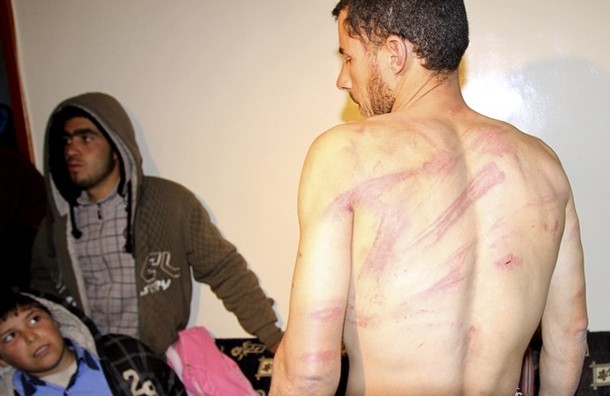
A Lebanese fisherman shows the marks on his back after he was arrested by Syrian forces with his nephew Maher Hamad in Arida town in northern Lebanon January 22, 2012. Syrian forces killed a Lebanese fisherman and wounded another when they seized a boat suspected of smuggling off the Lebanese-Syrian coast on Saturday (Reuters Pictures via Daylife).

Friday, January 27, 2012

A True Fraternity Between Lebanon and Syria

Lebanese and Syrian protesters burn a Hezbollah flag during a protest in solidarity with Syria's anti-government protesters, in the port city of Tripoli, northern Lebanon January 27, 2012.

Michael Young discusses Lebanon within the broader Arab Spring revolutions, as well as blossoming of a dream countless have died for: that of a healthy, fraternal relationship, based on mutual respect and sovereignty, between Lebanon and Syria. Excerpts from the article below:
On Wednesday the Syrian National Council, which is leading the opposition to the regime of President Bashar al-Assad from abroad, made a significant gesture toward Lebanon. 

In a statement the council promised, if it took power in Syria, to turn a “new page” with Lebanon. The rapport between the two countries would be built on a foundation of respect for sovereignty and parity, as well as support for ethnic and religious diversity and pluralism. The council promised to review bilateral agreements between Beirut and Damascus—above all the Syrian-Lebanese Treaty of Brotherhood, Cooperation, and Coordination, signed in 1991—and abolish the Higher Council that was set up through the treaty.

The Syrian National Council also undertook to terminate the role that Syria’s security services have played in Lebanon, and more broadly to end Syrian interference in Lebanese affairs. It said that it would demarcate the Lebanese-Syrian border, especially in the Shebaa Farms area, and affirmed that it would create a committee to investigate the matter of Lebanese held in Syrian prisons.

...

The relationship between Syria and Lebanon has been an orphan of the public debate over the Syrian uprising, indeed over Arab uprisings in general. The narrative of emancipation throughout the region has been focused internally, as one of populations rejecting authoritarian leaderships. There has been little room for a consideration of another type of subjugation, namely of one Arab state by another.

That is a reason, perhaps, why the Lebanese Independence Intifada of 2005 seemed to provoke so little interest last year among those taking to the streets against their regimes. And yet so much in that revolt against Syria was replicated elsewhere in the Arab world—from the way public space was used to stage protests, to the discussion of how to place instruments of state repression under democratic control, to the optimal way of approaching international intervention.

Anyone observing the barbarity of the Syrian leadership today cannot help but spare a thought for the Lebanese, who spent 29 years in one way or another under the Assads’ thumb. There were many in Lebanon who sided with Syria during that time; the violence inflicted by Lebanese on fellow Lebanese during the civil war was appalling. But a large number of those suffering during that period—the tens of thousands killed, injured, maimed, kidnapped or humiliated by Syria or its epigones—did not merit their fate, nor were they ever consulted about what Lebanon’s affiliation with Syria should be like.

...

The nature of Syria’s relations with the Lebanese, Palestinians, Iraqis, Jordanians and Turks will be essential for assessing the success of the Syrian uprising. Syria’s opposition still must triumph and then establish a democratic government. Yet given the Assads’ proclivity for destabilizing those around them, a new order in Damascus must make it a priority to place regional relationships back on an even keel.

To its credit, the Syrian National Council has taken the first step. Now it’s up to Lebanese democrats to push in the same direction from their end, to ensure the rapid start of a dialogue between governments once that becomes possible. Beirut and Damascus are intertwined. It’s a about time that both sides benefit in equal measure.

Monday, January 9, 2012

Qatari Aid to Syrian Refugees in Wadi Khaled

People unload trucks carrying Qatari aid to be distributed to Syrian refugees in the northern Wadi Khaled area. (Antoine Amrieh/The Daily Star)

Tuesday, August 9, 2011

Video: Assad Regime Troops Storm Family Home in Syria


Lebanese Intellectuals Protest in Support of the Syrian People

Top: Lebanese intellectuals and journalists protest during a vigil sit-in to show their support to the Syrian protesters who demonstrate against the Syrian President Bashar Assad, at the Martyrs square, in downtown of Beirut, Lebanon, on Monday Aug. 8, 2011. Despite five months of blistering attacks on dissent, the Syrian regime has yet to score a decisive victory against a pro-democracy uprising determined to bring down the country's brutal dictatorship. President Bashar Assad still has the military muscle to level pockets of resistance, but the conflict has robbed him of almost all international support. Second: Lebanese singer Marcel Khalifa, right, holds a candle during a vigil sit-in held by Lebanese intellectuals and journalists against the Syrian regime to show their support to the Syrian ... protest against the Syrian President Bashar Assad ... Bottom: A Syrian citizen holds a candle as other holds an Arabic placard read:"Every two hours one martyr fall," during a vigil sit-in held by Lebanese intellectuals and journalists against the Syrian regime ... (AP Photo via Daylife: here; here; here and here).

Tuesday, August 2, 2011

Ramadan Carnage in Syria

 The Financial Times reports:
The Syrian regime marked the first day of the holy month of Ramadan with an all-out assault on the protest movement, shelling the restive city of Hama, raising pressure for international action and provoking accusations of a sectarian war against the country’s majority Sunni Arab population.

An intense bombardment was reported in Hama when people were gathered for evening prayers. Tanks first resumed their attack on the city, where at least 80 people were killed on Sunday, in the early morning, with the crackdown also reported to be continuing in the eastern oil producing town of Deir Ezzor and reaching Al Bukamal near the Iraqi border.

Tanks were also reported to have stormed the town of Zabadani, a protest hotspot close to Damascus. At least eight people were estimated to have been killed in Monday’s violence.

As world powers prepared for a meeting of the UN Security Council, where Russia has so far blocked condemnation of its ally in Damascus, the European Union added five new names to its list of Syrian officials subject to asset freezes and travel bans.
...
US officials said Mrs Clinton would meet Syrian activists abroad on Tuesday.

Even Moscow warned the Syrian regime on Monday against the use of force on civilians. In Turkey, an increasingly frustrated ally of Syria, President Abdullah Gul said the images from Hama on Sunday had “horrified us”.

Protesters in Hama, site of a 1982 massacre by President Bashar al-Assad’s father that residents thought would never be repeated, remained defiant however.
...
As Ramadan dawned across Syria on Monday, the military moved in to position for another attack on Hama.

“This morning at 7.30 suddenly the city was bombed,” said Omar Habbal, an activist. “It was a very big bombardment which continued for 20-25 minutes.”

According to Mr Habbal, many of the city’s barricades, taken down by security forces on Sunday, have been rebuilt.

“We won’t give up because we have got a very big lesson from [the southern province of] Deraa, where they [the regime] took the boys and killed them and took them to mass graves.”
...
In a letter to the army, Mr Assad repeated the regime’s claim that Syria was facing a foreign conspiracy designed to sow sectarian strife and “tear Syria into small statelets that compete to satisfy those who worked to slice them up”.

Opposition activists, however, say it is the regime, dominated by the Alawite minority in a majority Sunni country, that has been deliberately stoking sectarian tensions to maintain the loyalty of minorities and raise the spectre of civil chaos.

Arab television stations have been broadcasting the unforgettable spectacle of mosque minarets with clouds of smoke over them in the conservative Sunni city of Hama on the eve of the holy month of fasting.

The Muslim Brotherhood, whose Syrian branch, which is banned inside the country has hitherto been very careful not to play up the sectarian aspect of the crackdown, issued a statement saying Syria was witnessing “a war of sectarian cleansing”.

“The regime has linked its open annihilation with the crescent of Ramadan. It is a war on the identity and beliefs of the Syrian nation ... on Arab Muslim Syria,” said the Brotherhood statement, reported by Reuters news agency.

Activists and analysts believe the escalating crackdown will prove counter-productive, just as previous attacks on other cities injected new momentum into the uprising.

“It an act of frustration and despair,” said Hilal Khashan, a professor of political science at the American University of Beirut. “[Assad] knows it will backfire.”

Wissam Tarif, a human-rights activist based outside of Syria, said the question was whether the regime was willing to kill many more people to disrupt the protests, especially in Hama. In Ramadan, says Mr Tarif “every casualty will be emphasised – ...”.

Sunday, July 31, 2011

Syrian Regime Troops Fire on Fleeing Refugees

A Syrian woman and her child, fleeing the violence in Syria, cross by foot into the Lebanese border village of Wadi Khaled, northern Lebanon near the Lebanese-Syrian border, July 19, 2011 (Reuters Pictures via Daylife)

The Dailystar reports:
Syrian forces opened fire on refugees fleeing into Lebanon early Saturday morning, a security source told the Daily Star.
The source said that around 30 families entered Lebanon between 3 a.m. and 4 a.m. through the unofficial border crossing at Lebanese border town of Kneisseh in the Wadi Khaled area in the north. The gunfire lasted about 20 minutes. 
Refugees began fleeing into Lebanon in large numbers two months ago following a crackdown on anti-government demonstrators in Syrian frontier towns. 
Since then, Syrian troops have tightened security along the Lebanese borders, preventing people from fleeing to Lebanon. However, many Syrians continue to cross into Lebanon through, often in the middle of the night. Some have been killed or wounded in the process. 
It is not known how many Syrian refugees have fled into Lebanon since the beginning of the uprising. There are 2,000 registered Syrian refugees in the country, according to the UNHCR, but it is believed the real numbers are significantly higher. 
Syria's four-month-long popular uprising, its largest since Hafez Assad took power 40 years ago, has claimed the lives of more than 1,400, say activists. Friday saw the largest show of demonstrators to date, with more than 1.5 million anti-government demonstrators taking to the streets across the country.

Friday, July 29, 2011

Yalla Irhal Ya Bashar!


Description:

Response from the streets of Hama to Bashar's speech, with additional music & translation added by the Creative Syrian Revolution. 

The singer "Ibrahim Qashoush" was reported to be killed in Hama on 3 July 2011 by regime mercenaries, they cut his throat to try to stop his chant spreading. Please spread this to prove them wrong and show their violence will never defeat us. Additional Music & Translation added by the Creative Syrian Revolution - http://www.facebook.com/CreativeSyrian

Raw video below:

Wednesday, June 15, 2011

Would a Victorious Syrian People Hand Bashar Assad & Cronies to the STL?

 
One of the first videos of Syria's Arab Spring. The regime's increasing brutality led to increasing numbers in the streets demanding freedom, rights and dignity.

Maybe its wrong to engage in such fanciful musings on the [near?] future while innocent civilians are today being crushed by tanks and tortured in cellars, but one question preoccupied me this morning.

The Question: Throughout the developments in Lebanon of the past 6 years, detractors of the STL have used the argument that even if the STL were to indict [let alone find guilty] top members of the Syrian regime, no organisation, government or body was going to go into Syria, catch them, and deliver them to the Hague for trial and/or imprisonment.  As the Arab Spring has swept through Syria, one possible body for the deliverance of those called to appear in the Hague has arisen, the Syrian people themselves. Would a victorious people's revolution in Syria hand over the top echelon of the Assad regime for prosecution in an international court for the murder and assassination of various Lebanese figures & personalities (including Rafic Hariri, of course) if it were possible? Or, given that the Syrian people have revolted against repression under the banner of dignity, would they insist that any prosecution of the Assad regime address first and foremost that regime's crimes against humanity perpetrated on the Syrian people? Their dignity and rights lend themselves the latter proposal, while the practicality of having a fully functional court and proceedings lend themselves to the former.  Both of the propositions are presume a lot ... a lot a lot ... but why not, who would've thought we'd be here six months ago?

Friday, May 27, 2011

Hizballah Still on the Wrong Side of Arab Spring

Video allegedly shows Syrian protesters in the city of Homs burning the Hizballah flag on May 22 2011.

Michael Young with an excellent view of Hizballah's headaches when it comes to the Arab Spring - and the Syrian Revolution in particular:
...
First, as hard as Nasrallah tries, he just cannot seem to convince Arabs anymore that “resistance” must be given priority over most other aspects of their lives. In Egypt, Tunisia and Syria, people have talked about emancipation, democracy and liberty, with the targets of their opprobrium almost exclusively domestic. Protestors may dislike America and Israel, but for now their aim is to rewrite failed social contracts, impose states that reflect their needs, and be rid of leaders and their families who have suffocated and robbed them for decades.
...
There was something terribly off-key in Nasrallah’s comments, showing how alienated he seems to be from the spirit of this Arab moment. The language of rockets, guns and combat is jarring against a backdrop of societies demanding freedom. In armed resistance there is an implicit call for regimentation, for compulsory unity and the banishment of dissent in the greater cause of defeating the enemy. Yet everything about the Arab uprisings has been directed at undermining regimentation and authorizing dissent. Those in the region know all too well that their despots have spent decades using the conflict with Israel as justification for building up vast military and security apparatuses to facilitate open-ended internal repression.

Nasrallah’s second cause of fear is that he’s on the wrong side of the revolt in Syria. Hezbollah, which has always claimed to be the champion of the downtrodden, is defending a leadership crushing its own people. Nasrallah is covering for the soldiers, security officers and gang members who have fired live ammunition at unarmed civilians, killing an estimated 1,100 people in the last two months. He is covering for the unit in Daraa that placed a prisoner under a tank tread before running him over twice, tearing him to shreds.

... The reaction on social media outlets was acerbic from many in Syria. They saw that in defense of his party’s and Iran’s interests, Nasrallah would abandon justice and applaud their tormentors. If Syrian protestors prevail, they will not soon forgive him his double-standards.

A third headache for Nasrallah is that he now finds himself at the epicenter of a sectarian confrontation in the Middle East. For a long time Hezbollah managed to transcend Sunni-Shia differences thanks to its accomplishments on an issue that most Arabs sympathize with, namely the battle against Israel. But much has changed since then. To a great extent Iran’s Arab enemies have made headway in portraying the Islamic Republic and Hezbollah as pursuing a project of Shia hegemony, regardless of the merits of such an accusation.

And in Syria Hezbollah’s ally, the Assad regime, also appears to be implementing a sectarian strategy. Many Arabs will have read or heard lately that Alawites are expelling Sunnis from places such as Tal Kalakh. Even diplomats in Beirut worry that this may be a step in establishing an ethnically cleansed Alawite mini-state. It would be disastrous for Nasrallah if a majority of Arabs were to begin lumping his Shia community together with the Alawites in an alleged partnership against Sunnis. He knows that for Hezbollah to be depicted as a sectarian group would undermine it as the vanguard in a model of regional resistance. And yet this has already started.

Hassan Nasrallah is behind the curve on what is going on around us in the Middle East. The Hezbollah leader is employing both rhetoric and imagery that are anachronistic in these transformative times. The future, we hope, will bring a promise of free societies, the reflexes of compromise and greater pluralism. If that fails, as it may, Nasrallah will have saved himself; but at the expense of many innocents.

Thursday, May 26, 2011

U.S. Weighs in on Lebanon-Syria Relationship


The alternative title for this post was, "Feltman: Syria is the North Korea of the ME" ... catchy! The LA Times reports:
The United States is upping pressure on Lebanon to reduce its ties to neighboring Syria in an effort to further isolate President Bashar Assad as his security forces violently suppress a pro-democracy movement, according to diplomats and officials.

Visiting Beirut last week, the State Department's Middle East envoy, Jeffrey D. Feltman, bluntly warned Lebanese officials that the tide had turned against the autocratic four-decade-old Damascus regime and urged them to distance themselves from a nation that has long been a major player in Lebanese political life, a Western diplomat and Lebanese officials said.

"There is no return back to the bad old days. Syria is going to change," a source with knowledge of the talks said, characterizing the U.S. message to Lebanon.

... Feltman warned that Lebanese leaders "risk being as isolated as Syria," which he characterized as "potentially the North Korea of the Middle East," said the source, who requested anonymity because of the private nature of the talks.
...
At the same time, the U.S. effort in Lebanon, a Western diplomat said, was one prong in a larger campaign to push the Arab world to stand against Syria's crackdown on protesters. Other steps have included outreach to such nations as the United Arab Emirates and Bahrain, which have sent emissaries and messages and support to Damascus in recent weeks. On Wednesday, a draft resolution by several European nations was submitted to the U.N. Security Council demanding that Syria stop the violence against protesters and cooperate with the U.N. investigation of alleged rights abuses.
...
Feltman, who arrived in Beirut late Thursday and left early Saturday, delivered his message to Mikati, Druze leader Walid Jumblatt, Hariri aide Mohammad Chatah and President Michel Suleiman ...
...
American officials are concerned that Lebanese ambivalence on the Syrian uprising has resulted in refugees and defecting Syrian soldiers being sent back home. "In Syria, deserting soldiers are executed," said the Western diplomat.

Some 4,000 families have fled Syria to Lebanon, most of them to the north via illegal border crossings, which Lebanese and Syrian armed forces vowed to close off Wednesday. Human Rights Watch last week warned Lebanon that it could be legally responsible for any harm suffered by refugees it sent back to Syria.

"We want to ensure that the people who are refugees are afforded all their rights," said the Western diplomat. "We had great concerns over the humanitarian implication of all this."

Syria and its allies have been increasingly flexing their muscles in Lebanon. Damascus' allies have sometimes violently disrupted peaceful demonstrations by Lebanese activists. A hotel in Beirut canceled a conference of intellectuals and journalists to demonstrate solidarity with the Syrian government.

Syria's surrogates have managed to create a climate of fear in Lebanon. Even traditionally anti-Syrian bastions have toned down their criticism of the Assad regime. Reporters and producers at Hariri's Future TV acknowledged that they've been ordered to ease criticism.

"There's been a little bending over backwards in order not to be perceived as meddling in what's happening in Syria," said Chatah, Hariri's aide. "The Syrians have been pointing fingers. Historically, Lebanon has been the scapegoat. In an effort not to be involved, most people have gone a little bit in the other direction of not saying much."

But some Lebanese are saying a lot about the unrest in Syria — mostly in support of the regime. Syria's allies in Lebanon often appear on pan-Arab television stations speaking out on behalf of Assad. "It seems like I only see Lebanese people on television defending the regime," said Rami Nakhle, a Syrian democracy activist in Lebanon.

Related Posts:

Friday, May 20, 2011

Dorothy Parvaz Discusses Detention in Syria

 
After returning to Doha, Al Jazeera journalist Dorothy Parvaz has described her experiences while being detained in Syria for three days and then in Iran for 16 more.

Parvaz was first held and interrogated in Damascus, Syria's capital, upon her arrival there on April 29 to cover anti-government demonstrations.

She was then deported to Iran. She was finally freed on Wednesday morning.

Wednesday, May 18, 2011

Erdogan has doubts about Assad

Protesters chant slogans as they hold Syrian flags during a demonstration after Friday prayers on April 29, 2011 in Istanbul against the regime of Syrian President Bashar al-Assad and the deadly crackdown on opposition protests. About 1,000 people demonstrated in Istanbul Friday to denounce a bloody crackdown on protests in Syria, calling for President Bashar al-Assad's departure. Following Friday prayers at an ancient mosque, the crowd, including Syrians based in Turkey's largest city, staged a march, chanting slogans against Assad and burning his portraits ... (Getty Images via Daylife)

Some light analysis,via Reuters, on Turkey's inability to get the Assad regime to reform (duh!):
...
Having embraced Assad as a new found friend in recent years, Prime Minister Tayyip Erdogan has been reduced to hand-wringing over the killing of unarmed civilian protesters after the Syrian leader turned tanks against their own cities.
...
Erdogan, whose foreign policy over the past decade has been to eliminate all Turkey's old problems with neighbours, increase trade and become a regional power, says that when the first Arab popular uprising broke out in Tunisia, he urged Assad to reform.

Late last month Erdogan sent his intelligence chief to Damascus to try to persuade Assad to take the reform path, but there was no sign of success. "Could Turkey have done anything more -- I don't think so," said Soli Ozel, a professor of international relations at Istanbul's Bilgi University.

"The real problem concerns Turkey's claims of influence, its abilities and capacities," he said. "It could not induce Bashar al-Assad or the Baathist regime to implement reforms in time."
...
"Syrian issues are almost an issue of domestic policy for us," Erdogan said on Monday in an interview with Channel 7, a Turkish television station regarded as close to his party.

Erdogan said more than 1,000 people had been killed in Syria and that he did not want to see a repeat of the 1982 bloodshed in Hama, where Assad's father crushed an Islamist uprising, or the 1988 gassing of Kurds in the Iraqi town of Halabja during the dictatorship of Saddam Hussein, who headed Iraq's Baathists.

Paul Salem, from the Carnegie Endowment think tank in Washington, said Turkey would have done better in the eyes of many Arabs by speaking out more strongly against the actions of Assad and Libyan leader Muammar Gaddafi's security forces.

"The Arab uprisings are effectively calling for the Arab world to be more like Turkey, democratic, with a vibrant civil society and political pluralism, secularism alongside Islam, and a productive and fairly balanced economy," Salem wrote in the Los Angeles Times this week. "This could have been Turkey's moment in the Middle East: the moment was lost."
...
"So far, the Iranians have more influence on the Syrian government than the Turkish government," Walid Saffour, the London-based president of the Syrian Human Rights Committee, told Reuters during a meeting of Syrian opposition and rights groups in Istanbul in late April.

"But I think if the Syrian government is sane enough to listen to the language of logic, it will listen to the advice of the Turkish government."

Hardliners in the Syrian government could be antagonised if Erdogan pushed harder for urgent reforms and more restraint.

"Because Turkey couldn't unequivocally support the Syrian regime the way Iran has, the Syrians are rather cross with Turkey," said Ozel. "Relations are going to be frostier."

Turkey and Syria, which share an 850-km (530-mile) border, have come along way since 1998 when they almost went to war over Kurdish militants operating from Syrian territory.

Erdogan and Assad have had a visible rapport. In the past couple of years visa requirements were dropped for travel between the two countries, and Turkish and Syrian ministers have held regular strategic cooperation meetings.

Just a couple of weeks earlier, Erdogan revealed growing uncertainty over Assad's intentions regarding reforms.

"Honestly I am having doubts," Erdogan told the ATV news channel, adding he was unsure if Assad was being blocked, or he feared that reforms would not work, or he was being indecisive.
...
Critics say that Erdogan's reluctance to choose sides stems from concern over Turkey's sizable business interests in Libya and Syria. Though in the case of Libya, Erdogan's first priority was evacuating more than 20,000 Turks working there.

... It is a familiar position for Erdogan to be in. Two years ago he congratulated Iranian President Mahmoud Ahmadinejad for his victory in an election the opposition said was fixed.

Last year, Erdogan opposed the imposition of more U.N. sanctions on Iran over its refusal to curb its nuclear energy programme and dispel concerns that it may be aimed at developing atom bombs, rather than generate electricity as Tehran says.
...
... Despite having good relations with repressive governments, they [the Turks] say they want democracy to triumph in the region. They had no qualms about the toppling of autocrats in Egypt and Tunisia in January and February.
...
For Turkey, Lebanon and Iraq, nowhere poses more risk than Syria, with its mix of Sunni Arabs, Alawites, Kurds and Druze.

"This will hit us in the end," Erdogan told ATV two days after the first refugees crossed into Turkey in late April.