Showing posts with label Hizballah. Show all posts

Monday, November 5, 2012

STL Suspect Hussein Oneissy at Wissam Hassan Assassination?

Lebanese commentators are abuzz about allegations that a Hizballah operative indicted by the Special Tribunal for Lebanon for the assassination of former Premier Rafic al Hariri, was seen at the scene of the assassination of ISF Information Branch chief, Gen. Wissam al Hassan.
 
On November 2nd, Akhbar el Nasher reported on a tweet by journalist Maria Maalouf in which she wrote that Future MP Nohad Mashnouq had informed her that video images captured at the scene of the crime showed Salim Ayyash at the scene.
 
On Novemeber 3rd, a Youtube video published by Radio Sawt Beirut showed what claimed to be Hussein Oneissi at the scene of the explosion.  Meanwhile, journalist Nadim Koteich revealed via twitter that high ranking politicians within the March 14 movement had information that the assassinated Hassan had obtained images of one of the STL indictees and was monitoring his movements, and that that information had been shared with the President's office in Lebanon. 


The assassination of Gen. Hassan has been widely blamed on the Assad regime, with some noting that the operation would've requried the involvement of a local group allied with the regime, the most proficient of which is Hizballah.  The Information Branch, which Hassan headed, was credited with the disruption of major terrorist cells affiliated with the Assad regime, as well as a large number of Israeli agents and cells.  Most recently, Hassan was believed to have been behind the arrest of former Lebanese minister, and close Assad associate, Michel Samaha, who has confessed to transporting explosives across the Syrian-Lebanese border for use in terrorist and assassination operations at the behest of the Assad regime.
 
In addition, the Information Branch was seen as a uniquely singular organization in which Hizballah and other Assad organs in Lebanon did not have a controlling hand.  This status is believed to have been enshrined in the Doha Accord which came about after the Hizballah invasion of Beirut in May 2008.  Seen from this perspective, the assassination of Wissam Hassan has been viewed as a critical strike by Hizballah aimed at consolidating power in Lebanon amid instability in neighboring Syria and the theat of a strike on Iran's nuclear facilities.

Update: As suspected (pun intended) it was revealed that the person seen in the video was just of an unfortunate resemblence to Hussein Oneissi.  The STL revealed, after examining video evidence of the crime scene that no indictees were visible.  Here is the Naharnet article.

Sunday, October 21, 2012

Lebanon's Flag at Half Mast


The Lebanese flag was raised at half mast at the Presidential Palace and the Grand Serail on Saturday in mourning for General Wissam al Hassan, who was assassinated on October 19th, 2012.  General Al Hassan was head of the Intelligence Bureau at the Internal Security Forces and was widely credited with the infiltration, capture and dismantling of numerous Isreali and Syrian clandestine cells in Lebanon.  Most recently, General al Hassan uncovered an extensive terrorism/assassination campaign ordered by Assad regime stalwarts, arresting former Lebanese minister Michel Samaha and issuing indictments against Syrian General Ali Mamlouk in the process.  The Assad regime has been widely blamed for this assassination, with some pointing a finger at Hizballah as a participant.

Friday, May 27, 2011

Hizballah Still on the Wrong Side of Arab Spring

Video allegedly shows Syrian protesters in the city of Homs burning the Hizballah flag on May 22 2011.

Michael Young with an excellent view of Hizballah's headaches when it comes to the Arab Spring - and the Syrian Revolution in particular:
...
First, as hard as Nasrallah tries, he just cannot seem to convince Arabs anymore that “resistance” must be given priority over most other aspects of their lives. In Egypt, Tunisia and Syria, people have talked about emancipation, democracy and liberty, with the targets of their opprobrium almost exclusively domestic. Protestors may dislike America and Israel, but for now their aim is to rewrite failed social contracts, impose states that reflect their needs, and be rid of leaders and their families who have suffocated and robbed them for decades.
...
There was something terribly off-key in Nasrallah’s comments, showing how alienated he seems to be from the spirit of this Arab moment. The language of rockets, guns and combat is jarring against a backdrop of societies demanding freedom. In armed resistance there is an implicit call for regimentation, for compulsory unity and the banishment of dissent in the greater cause of defeating the enemy. Yet everything about the Arab uprisings has been directed at undermining regimentation and authorizing dissent. Those in the region know all too well that their despots have spent decades using the conflict with Israel as justification for building up vast military and security apparatuses to facilitate open-ended internal repression.

Nasrallah’s second cause of fear is that he’s on the wrong side of the revolt in Syria. Hezbollah, which has always claimed to be the champion of the downtrodden, is defending a leadership crushing its own people. Nasrallah is covering for the soldiers, security officers and gang members who have fired live ammunition at unarmed civilians, killing an estimated 1,100 people in the last two months. He is covering for the unit in Daraa that placed a prisoner under a tank tread before running him over twice, tearing him to shreds.

... The reaction on social media outlets was acerbic from many in Syria. They saw that in defense of his party’s and Iran’s interests, Nasrallah would abandon justice and applaud their tormentors. If Syrian protestors prevail, they will not soon forgive him his double-standards.

A third headache for Nasrallah is that he now finds himself at the epicenter of a sectarian confrontation in the Middle East. For a long time Hezbollah managed to transcend Sunni-Shia differences thanks to its accomplishments on an issue that most Arabs sympathize with, namely the battle against Israel. But much has changed since then. To a great extent Iran’s Arab enemies have made headway in portraying the Islamic Republic and Hezbollah as pursuing a project of Shia hegemony, regardless of the merits of such an accusation.

And in Syria Hezbollah’s ally, the Assad regime, also appears to be implementing a sectarian strategy. Many Arabs will have read or heard lately that Alawites are expelling Sunnis from places such as Tal Kalakh. Even diplomats in Beirut worry that this may be a step in establishing an ethnically cleansed Alawite mini-state. It would be disastrous for Nasrallah if a majority of Arabs were to begin lumping his Shia community together with the Alawites in an alleged partnership against Sunnis. He knows that for Hezbollah to be depicted as a sectarian group would undermine it as the vanguard in a model of regional resistance. And yet this has already started.

Hassan Nasrallah is behind the curve on what is going on around us in the Middle East. The Hezbollah leader is employing both rhetoric and imagery that are anachronistic in these transformative times. The future, we hope, will bring a promise of free societies, the reflexes of compromise and greater pluralism. If that fails, as it may, Nasrallah will have saved himself; but at the expense of many innocents.

Saturday, May 21, 2011

U.S. Court Filing: Iran helped Al Qaeda Plan 9/11 Attacks


The New York Times reports:
Two defectors from Iran’s intelligence service have testified that Iranian officials had “foreknowledge of the 9/11 attacks,” according to a court filing Thursday in a federal lawsuit in Manhattan that seeks damages for Iran’s “direct support for, and sponsorship of, the most deadly act of terrorism in American history.”

Imad Mugniyah, the Hezbollah leader killed in 2008, also was accused of a role in 9/11.

One of the defectors also claimed that Iran was involved in planning the attacks, the filing said. The defectors’ identities and testimony were not revealed in the filing but were being submitted to a judge under seal, said lawyers who brought the original suit against Iran on behalf of families of dozens of 9/11 victims.
...
The suit contends that Iran and Hezbollah, the Lebanese militant organization with close ties to Tehran, helped Al Qaeda in planning the attacks on Sept. 11, 2001, and in facilitating the hijackers’ training and travel. After the attacks, the suit contends, Iran and Hezbollah helped Qaeda operatives escape, providing some with a safe haven in Iran.
...
In their court papers, the lawyers assert that Imad Mugniyah, as the military chief of Hezbollah, was a terrorist agent for Iran, and that he traveled to Saudi Arabia in 2000 to help with preparations for the 9/11 attacks.
...
The 9/11 commission report said there was “strong evidence that Iran facilitated the transit of Al Qaeda members into and out of Afghanistan before 9/11, and that some of these were future 9/11 hijackers.” The report also said there was circumstantial evidence that senior Hezbollah operatives were closely tracking the travel of some of the hijackers into Iran in November 2000.

But the commission said that it had “found no evidence that Iran or Hezbollah was aware of the planning for what later became the 9/11 attack,” and that the “topic requires further investigation by the U.S. government.”

Thomas E. Mellon Jr., a lawyer for the families, said the suit, first brought in Washington in 2002 and later moved to Manhattan, sought to do that investigation.
...
The lawyers’ filing included reports of 10 specialists on Iran and terrorism, including former 9/11 commission staff members and ex-C.I.A. officers. “These experts make it clear that 9/11 depended upon Iranian assistance to Al Qaeda in acquiring clean passports and visas to enter the United States,” Mr. Mellon said.

But the expert reports do not in most cases seem to go as far as the defectors in contending Iran had foreknowledge of the attacks.

The filing says the defectors worked in Iran’s Ministry of Information and Security “in positions that gave them access to sensitive information regarding Iran’s state sponsorship of terrorism.” It says they have reason to fear for the safety of themselves and their families “should their identities and the content of their testimony be revealed publicly.”

Tuesday, May 3, 2011

Images from Illegal Construction Confrontations

Top: Lebanese soldiers deploy to disperse residents at a street in Tyre, southern Lebanon, April 21, 2011. Two civilians were killed during clashes between residents and security forces over the illegal constructions on public lands in Tyre, southern Lebanon, the National News Agency (NNA) reported (source).  Second: A police car is set on fire by residents in Tyre, southern Lebanon, April 21, 2011. ...(source).  Third: Residents seize a police car in Tyre, southern Lebanon, April 21, 2011. ... (source).  Fourth: A man stands at the entrance of a shop in the building of an illegal construction site in Beirut's southern suburb of Ouzai, Lebanon, Thursday, April 21, 2011. Security officials say a dispute over a building permit in southern Lebanon has descended into a gunbattle that killed two people. Illegal construction is common in Lebanon, where many poor who cannot afford to buy land or apartments end up building on state-owned property (source). Bottom: A set of replica rockets which have been set up by Hezbollah in front of a picture of disappeared imam Moussa al-Sadr and a site where laborers are working at an illegal construction site in Abu Aswad near the southern port city of Tyre, Lebanon, Thursday, April 21, 2011. ... (source).

Wednesday, April 13, 2011

Thoughts On Avoiding Another Civil War


Michael Young airs out some thoughts on how the Lebanese can avoid another civil war:
Next week Lebanon will commemorate, doubtless in vapors of indifference, the 36th anniversary of the start of its civil war. Indifference is not necessarily a bad thing, but given the polarization in the country today, particularly between the Sunni and Shia communities, a look back is necessary.

In 1975 Lebanon did not seem like a country on the verge of a 15-year conflict. There were those who saw through the glitz of the era, the nights at the Caves du Roy and the imperishable cliché that one could swim in the sea and ski on the same day. Toufiq Youssef Awwad’s novel Tawaheen Beirut, like Ziad al-Rahbani’s brilliant, caustic plays, offered literary glimpses into the often impossible social contradictions the Lebanese had to juggle. Political life was, like today, deadlocked, the Lebanese divided over the role of the state, their social contract and the armed Palestinian groups in their midst.

... [Today] there is still no consensus over a Lebanese social contract, still no broad accord when it comes to the state, and still a highly volatile quarrel over weapons not under the authority of the state, in this case those of Hezbollah. And you can still ski and swim on the same day.
...
How might the memory of war help us today? The priority for the political class in the foreseeable future, on all sides of the Lebanese divide, is to avert a conflict between Sunnis and Shia and create a framework for serious dialogue between the two communities. This may sound terribly trite, and it is illusory today to expect that the factions will find substantial common ground. The projects advanced by the March 14 coalition and by Hezbollah are largely incompatible, at least in the forms expressed by representatives on both sides.
...
It is doubtless necessary for Nasrallah to climb down from his high perch, one from where he believes that he can intimidate his political adversaries to change their views on a host of crucial national issues, ranging from their support for the Special Tribunal for Lebanon to their disapproval of Hezbollah’s weapons. But it is also vital that Hariri take more steps of his own, for example reestablishing a relationship with Nabih Berri. From Hariri’s perspective, the parliament speaker has a lot going against him. Yet March 14 twice elected him to his post after the Independence Intifada of 2005, even though Berri had done everything to undermine the then-parliamentary majority.

Above all, Lebanon needs a government. That March 14 has chosen to remain in the opposition is constitutionally legitimate. However, at this stage, with so much uncertainty in the country and in the Arab world, it really makes more sense for it to join the government, on condition that it receive veto power. The former majority would thus place itself in a position to defend its stakes, including the Special Tribunal, and build useful coalitions with President Michel Sleiman, Prime Minister Najib Mikati, and even Walid Jumblatt on myriad issues. None of the three relishes the thought of seeing the government turned into a battering ram for Hezbollah and Michel Aoun.

Mikati may well agree to grant March 14 veto power, as it would allow him, finally, to form a governing team. More importantly, a new government would allow for politics within the confines of national institutions. Better in the cabinet than in the streets.

As Michel Chiha, an essential ideologue of the Lebanese system, wrote in 1936 that Lebanon’s diversities can only be brought nearer to one another “by allowing them to live politically together, by allowing them to make laws together in an Assembly and to control the implementation of these laws.” The government is one such assembly, but there are, potentially, many others. As the April 13 anniversary looms, let’s remember that Lebanon is condemned to manage its differences in consensual ways; otherwise the shadow of war will never be far enough away.

Sunday, April 10, 2011

Hizballah on the Wrong Side of the Arab Spring

 Writing in the UAE's The National, Michael Young observes the difficulties now faced by Hizballah:
...
One organisation in particular, Hizbollah, is warily watching developments, and not only in the Middle East. Growing sectarian polarisation in the Gulf, protests in Syria, the likely naming of Hizbollah members in the assassination of the former Lebanese prime minister Rafik Hariri, and even the difficulties faced by Shiite expatriates in Ivory Coast have all heightened anxieties in party ranks. Hizbollah has also seen its political influence inside Lebanon shaken lately, as it faces deepening Sunni hostility.

Most of Hizbollah's injuries have been self-inflicted. As the recent protests in Bahrain took on a sectarian coloring, the party's secretary general, Hassan Nasrallah, proclaimed his solidarity with the kingdom's Shiites and condemned the ruling Al Khalifa family. The upshot was to effectively jeopardise the livelihood of thousands of Lebanese, especially Shiites, working in Bahrain and the Gulf. The Bahraini authorities interrupted air links between Manama and Beirut and warned of further retaliatory measures. Now Sheikh Nasrallah must explain to his co-religionists still in the kingdom, or who have had to leave, why he dragged them into a battle that was not theirs.

Lebanese earning a living in the Gulf, Shiites above all, will be equally alarmed by the growing tension between the Gulf Cooperation Council states and Iran. Lebanon offers few economic opportunities and relies heavily on foreign remittances. There would be severe repercussions if Gulf labour markets were closed to them for political reasons. Most expatriates have no interest in being associated with Hizbollah's militancy, even less Iran's. Sheikh Nasrallah knows this, but is caught between balancing the preferences of his Lebanese followers with his allegiances to Tehran and its regional agenda.
...
Hizbollah has been even more uncomfortable with the ongoing repression in Syria, which potentially threatens an Assad regime that has supported and armed the party. Not only has the Syrian revolt shattered the narrative that Arab dissatisfaction is directed solely against the United States, it has placed Hizbollah on the side of the oppressors. For a party that purportedly identifies with the deprived everywhere, this poses problems. Hizbollah's Al Manar television station has played down the Syrian regime's brutality, even as the death toll has risen.
...
Not surprisingly, Lebanese Sunni-Shiite relations have worsened markedly, feeding off regional sectarian polarisation. Hizbollah has long tried to sell itself as the vanguard of a unified Arab resistance to Israel and the United States. For it now to be pigeonholed as a sectarian organisation under Iran's thumb represents an important step backward. In that context, any charge that the party contributed to the murder of a major Sunni leader like Rafik Hariri is anathema.
...

Wednesday, September 29, 2010

What Happened at the Airport?

A Lebanese general security (front) and Hezbollah security are seen standing outside the home of former Lebanese Brigadier-General Jamil Sayyed (poster) following his arrival from a trip to Paris, on September 18, 2010. Sayyed, who was jailed for four years in Lebanon without charge in connection with the killing of ex-premier Rafiq Hariri in 2005, accused current premier, Saad Hariri, earlier in the week of selling his father's blood in order to frame Syria for the killing, prompting the country's top prosecutor to summon him for questioning. (Getty Images via Daylife)

NOWLebanon's Ana Maria Luca details Hizballah's coercive use of its arms and militiamen at Beirut International Airport:
When Major General Jamil as-Sayyed stepped off his plane from Paris at the Beirut International Airport on September 18, he was welcomed by Hezbollah gunmen, who drove onto the runway in vehicles without license plates and took him to the airport’s VIP lounge. Although he no longer holds an official position in the Lebanese government, the former head of General Security ... held a press conference in the Foreign Ministry’s lounge, designated for heads of state and ministers. Then he was escorted home by the same armed men.

Neither the Ministry of Foreign Affairs nor the Ministry of Interior was asked for permission for the armed guards to have access to the airport runway and the VIP lounge. But nobody moved a finger to stop them.

Some say that the event was a power play on Hezbollah’s part to send a message to the government that it has the military strength to fight back in case some party members are indicted by the Special Tribunal for Lebanon .... Hezbollah’s representatives defended the incident, saying the party acted within its rights.
...
A source in the airport, who spoke on condition of anonymity for fear he would be harmed, confirmed that the airport security officers had orders from high-ranking politicians not to intervene when the Hezbollah escorts drove their tinted-windowed cars onto the tarmac. The source also said the airport security officers were afraid that if they tried to stop the Hezbollah agents protecting Jamil as-Sayyed, they might have opened fire at them.

According to Moukalled, the event was one of the rare occasions when Hezbollah vehicles and the party’s armed security officers are shown on television. “This is the first time we see them after May 7, 2008,” she said. “They don’t usually let us film them. Even on May 7, 2008, they closed TV stations, stopped journalists from filming and confiscated some of the footage so that they wouldn’t be seen on camera. Everything was planned. The media knew hours before that there were going to be Hezbollah bodyguards at the airport. It was a clear power play.”
...
According to Minister of State Jean Ogassapian, Interior Minister Ziad Baroud submitted a report during last Tuesday’s cabinet session asserting that “the armed men who entered the airport were MPs’ bodyguards.” Ogassapian said he found it a weak excuse and argued that the government should have dealt with the incident differently.

Baroud answered back in a short statement issued by his office after the cabinet meeting, saying that he wants to keep the Beirut International Airport safe.

Hezbollah’s response to the controversy came from Loyalty to the Resistance MP Nawwaf al-Moussawi, who said that "What happened at the airport was our right as MPs and political sides to open the VIP lounge and to be present there because we are the makers of honor. There will be no compromise on defending ourselves from false accusations, and we have the right to use what we believe appropriate for that.”
...
Related Posts:

Friday, September 10, 2010

Hizballah's New War Museum

Michael Young on Hariri's "Accusations Against Syria"

Michael Young on Hariri's "political accusations against Syria" statement:
...
The phrasing of Hariri’s statement was revealing. After making his remarks about the politicized accusations against Syria, the premier added that the tribunal was continuing its work, lending it some legitimacy. It wasn’t much, but it was enough to dissatisfy Hizbullah. What Hariri did, or tried to do, was to implicitly repeat the Der Spiegel line from last year (which more than ever appears to have been the consequence of Syrian manipulation), namely that Damascus is innocent but that the tribunal is ongoing, therefore its conclusions, even if Hizbullah is named, are worth considering.

Hariri’s calculation was probably to retain some semblance of leverage over Hizbullah. The Syrians, playing both sides of the aisle in order to advance their own interests in Lebanon, have been encouraging their Lebanese megaphones to discredit the tribunal and call for its dissolution, even as they have avoided putting direct pressure on Hariri to end cooperation with the institution. The Syrians are still thinking of using an indictment in ways that expand their power, but they, like Hizbullah, ultimately want the tribunal to be killed from the Lebanese side, so that it won’t harm them.

... The prime minister may want to retain leverage, but his chances of succeeding are diminishing by the day, and the Syrians win either way. What weakens Hariri helps them; what weakens Hizbullah helps them; and a dispute between Hariri and Hizbullah helps them, too. Indeed, today they find themselves indirectly, and agreeably, mediating between the prime minister and Sayyed Hassan Nasrallah through Walid Jumblatt, whose reference point in Damascus is Mohammad Nassif, one of the late President Hafez Assad’s closest collaborators.

... Lebanese state institutions form the implementation arm of the tribunal; Lebanese judges sit on the panel; Bellemare’s deputy, Joyce Tabet, is a Lebanese magistrate. Of course the Canadian prosecutor can sit in a remote office and craft an indictment, as he should, but if the Lebanese state is not on board, his [Bellemare’s] work could well end up being an empty intellectual exercise.
...
Related Posts:

Thursday, September 9, 2010

More Commentary on Hariri's Syria Statements

In the National's Opinion section:
Lebanese politics have a way of turning even the most starry-eyed participant into a pragmatist. The recent statements by the Lebanese prime minister Saad Hariri are something all together different, even by the standards of his country’s politics.
...
It was the culmination of months of diplomacy that began with a surprising visit by Mr Hariri to Damascus last December.
...
By pre-empting the conclusions of the tribunal, Mr Hariri has attempted to establish himself as neutral party prior the court's indictments ... [and] promote short-term stability in Lebanon, [however,] its longer term consequences are far less certain, and even less optimistic.

Mr Hariri's about-face must be framed in the context of Saudi Arabia's efforts to mend fences with the mercurial leadership in Damascus and promote regional quiet as tensions with Iran simmer.
...
Syria has simply leveraged its ability to be a spoiler for its own gain as others in the region attempt to confront Iran's nuclear ambitions. Once again, it seems, Lebanon has fallen victim to forces and problems far away.
 The Daily Star noted Nabil Qaouk, Hizbullah’s official in south Lebanon, comments,
"All parties seem to agree false witnesses misled investigations and led to an internal crisis and harmed Lebanese-Syrian ties during the past five years, ... Thus it is our national and moral responsibility to put on trial those false witnesses, those who stand behind them and their operators as a step to resolve the Lebanese crisis because some still insist on protecting false witnesses to protect higher security, political and judicial officials behind them.
as well as those of Hizbullah's Loyalty to Resistance bloc MP Qassem Hashem , who said that Hariri's stances,
"enforced demands to probe false witnesses as a national and legal duty to uncover the truth in former Premier Rafik Hariri's murder."
while Talal Arslan, leader of the predominantly Druze Lebanese Democratic Party,
... also demanded Hariri declare Hizbullah innocent of involvement in his father’s murder.

"Which will lead to abolishing Israeli attempts to instigate internal strife."
Naharnet reported that,
Progressive Socialist Party leader Walid Jumblat ... has said that Prime Minister Rafik Hariri's stances stress the importance of the Saudi-Syrian umbrella and the Taef accord.

Hariri is convinced of his personal ties with Syrian President Bashar Assad and the political relationship with Damascus, Jumblat told al-Akhbar newspaper in remarks published Tuesday.
...
In his weekly editorial to al-Anbaa, Jumblat said political and media calm are imperative to protect Hizbullah and the Special Tribunal for Lebanon.
...
Jumblat called on the various political parties to stick to soft rhetoric "because the alternative is devastating and will bring the country to where no one wants."
NOWLebanon quoted comments by Lebanese Forces MP Joseph Maalouf to the Akhbar Al-Yawm news agency indicating that
... Saad Hariri ... did not say that Syria was innocent in the 2005 assassination of former Prime Minister Rafik Hariri.
...
PM [Saad] Hariri spoke about politically accusing Damascus [only],
Reporting on Lebanon First bloc MP Oqab Saqr's comments regarding Hariri's statements, Naharnet writes,
[Saqr] noted ... that whenever attempts are made to improve ties with Syria, there are some sides that try to thwart these efforts.

He told LBC that once the relationship between Prime Minister Saad Hariri and Syrian President Bashar al-Assad improved, the premier apologized for mistakes made against Syria after the assassination of former Prime Minister Rafik Hariri.

"Syria will make an apology of its own once the indictment is announced," he stressed.

"Assad himself said that Syria had committed errors in Lebanon and Syrian Foreign Minister Walid al-Muallem recognized the existence of the Special Tribunal for Lebanon," the MP continued.

Saqr called for putting an end to debates over false witnesses in the case.

In addition, the MP urged Hizbullah to take Hariri's recent positions into consideration, saying that the lack of an indictment does not favor the party because the indictment itself will only prove that the party was not involved in the assassination.
Phalange Party MP Elie Marouni was also quoted asking:
"Why didn't the reevaluation of positions start in 2006? What led to Hariri's visit to Syria and the shift in accusations against it? Was a political price paid?"
Nabih Berri, whose (in)actions speak louder than his words, briefly commented on Hariri's statements by referring to them as a "window to the truth."

While Al Sharq Al Awsat followed up on its Hariri interview with the following quotes and observations,
...
Western-backed Lebanese Prime Minister Saad Hariri has shuttled to Damascus five times in the last nine months to try to repair relations that frayed after the 2005 Syrian withdrawal. For many in Lebanon, the trips harken back to times of Syrian dominance when Lebanese leaders used to travel frequently to Damascus to get marching orders.
...
Although officials have not said it openly, analysts say the current rapprochement appears to be an acknowledgment that Hariri is too weak to govern Lebanon without the support of his larger, more powerful neighbor.
...
"Syria had been placed in the docket for the murder of (Hariri's) father ... and for him to look the world in the eye and say 'I was wrong' — it's an extraordinary about-face," said Joshua Landis, an American professor and Syria expert who runs a blog called Syria Comment.

"We understand that the Cedar Revolution was a mirage," he added. "And so we have returned to the much more cynical but perhaps more realistic world of cutting deals and keeping all the local powers happy."
...
Dory Chamoun, a March 14 politician, said Hariri's comments did not absolve Syria but were meant to emphasize that the tribunal must have the final word.

"If such statements ensure a calm situation in Lebanon, then I'm all for it," he said.
...
In Syria, state-run newspapers ran Hariri's comments on their front pages and political analysts close to the Syrian leadership said Syria considered Hariri's statements to be an apology.

"Such an apology is a courageous move by Hariri and we as Syrians regard his statements as restoring some esteem for Syria after years of slandering it," said analyst Imad Shueibi. "What happened is in fact a positive thing," he added.

Though Hariri has not explained his dramatic shift, analysts say he appears to be putting aside his deeply personal feud with Syria for the good of his own country as his Western-backed bloc struggles to maintain control.
...

Wednesday, September 8, 2010

Commentary on Hariri's "Errors" Bombshell

The AFP has some commentary on Hariri's "errors" comment in Monday's edition of the Saudi daily, Asharq Al Awsat:
...
"All you have to do is read the history of Lebanon to understand that there are no solutions in Lebanon without Syria," said Karim Makdisi, a political science professor at the American University of Beirut.

"Officials in Lebanon cannot be against Syria," Makdisi told AFP. "That is just not an option, and Hariri has realised that."
...
... on Monday, the prime minister was quoted as saying he had erred.

"At some point, we made a mistake," Hariri told the Saudi-owned daily Asharq Al-Awsat. "At one stage, we accused Syria ... That was a political accusation, and that political accusation is over."
...
Hariri's retraction, which one Lebanese daily dubbed a "political bomb," comes amid high tension in Lebanon over pending indictments by the Special Tribunal for Lebanon, a UN-backed probe into the assassination.
...
Analysts say Hariri's statement to Asharq Al-Awsat is yet another attempt to contain the current tensions, which have sparked fears of renewed sectarian violence.
...
"It's a precautionary move before the tribunal issues its charge sheet, which could implicate a Lebanese party, and is rooted in fear of the repercussions of that indictment," Khoury told AFP.
...
"Hariri is definitely under Saudi pressure to improve ties with Syria ... and there seems to be an attempt in the region to break the Syria-Iran-Hezbollah alliance," Makdisi said.
...
But Makdisi noted that Hariri stopped short of making any mention of Hezbollah.

"It is true that Hariri has never accused Hezbollah but in light of current tensions he could have gone on and openly said that he did not accuse Hezbollah, as well as Syria," Makdisi said.

Fadia Kiwan, head of the political science department at Saint Joseph University, argues that one party stands to gain from Hariri's political metamorphosis: Syria.

"After a difficult phase from 2005 to 2007, Syria's power is once again consecrated," Kiwan told AFP. "This will also put Syria's allies in Lebanon in a position of even more power.
...
Al Jazeera's Beirut correspondent, Rula Amin, writes:
We have to remember this is not a very surprising turnaround. ... Hariri has been reaching out to Syria and the Syrian president in the past years since he took office and became Lebanon's prime minister. ... He went to Damascus about four times, he met with the Syrian president who drove him around Damascus in his own car, had dinner together, hosted him in his own palace.

We have to also remember the political picture here has changed in the region. When Hariri accused Syria, Syria was isolated, the US was trying to isolate it, trying even to change the regime there. ... Now Syria has emerged from its isolation as a very strong player in the region ... and so Hariri has to adjust.
...
Regarding the STL, Hariri was quoted by the paper as saying, "the tribunal is not linked to the political accusations, which were hasty ... The tribunal will only look at evidence."

Meanwhile, Syria's unofficial spokesman in Lebanon, Wiam Wahab seemed to welcome the statement, even while calling for the labeling as an "Israeli agent" anyone that finances the Special Tribunal for Lebanon, and attacking the Prime Minister for "six childish years", Naharnet reports.

Wahab has also recently been vocal in his reminders of Syrian readiness and willingness to intervene if any "strife" were to arise, as well as continuous attacks against the STL, UNIFIL, and the pro-sovereignty March 14 movement.

Wahab has, in the past, accused Saudi Arabia of assassinating former Prime Minister Rafik Hariri.

Related Posts:

Tuesday, September 7, 2010

March 8 Parties Petition for the Dissolution of the STL

NOWLebanon reports that a delegation representing March 8 parties, traditionally allied to Syria and, in the case of Hizballah, Iran,
...visited UN Special Coordinator for Lebanon Michael Williams’ office on Saturday and delivered a memorandum asking UN Secretary General Ban Ki-moon to abolish the Special Tribunal for Lebanon (STL)...
...
The memorandum calls for the UN to replace the STL with a joint Arab-Lebanese commission to investigate the 2005 assassination of former Prime Minister Rafik Hariri...

... the March 8 parties also submitted the same memorandum to the Chinese and Russian embassies in Lebanon.
Absent from the memorandum was the signature of AMAL, the pro-Syrian half of the duopoly currently claiming [political] representation of the Shiite community in Lebanon.

AMAL has staked out increasingly divergent positions from those of Hizballah over the past several weeks and months.  This comes as  Syria  engages in a power struggle with Hizballah over influence in Lebanon.  That struggle translated into violence several ago in a fire fight started in the Burj Abi Haidar neighborhood of Beirut.

Related Posts:

Friday, September 3, 2010

Syria's Allies Take Their Allotted Places

Michael Young's Thursday editorial echoes some of the sentiments expressed in my last post while elaborating on the Hizballah-Ahbash clash in Beirut and the Syrian-Iranian maneuvering over Lebanon:
...
It is ironic that Berri’s stalwart defense of the Lebanese state and its sovereignty should only serve to strengthen the hand of Syria in the struggle over Lebanon’s future, the same Syria that ravaged both the state and its sovereignty during its 29-year military presence.

In that light, it appears increasingly clear that the Burj Abi Haidar incident last week was less a Hizbullah signal directed at Damascus that it would not bend in the face of Syrian pressures, than a message from Syria to Hizbullah. As the fighting began, there was military mobilization in Sunni neighborhoods around Burj Abi Haidar, with Syria’s allies there bringing out their weapons. Hizbullah was reportedly bewildered by the sudden proliferation of armed groups lining up against the party, even as its units were being bussed into the area where the clashes were occurring. Hizbullah not only had to swallow the killing of two officials, it was unable, or not allowed, to enter the perimeter around the Ahbash mosque in Burj Abi Haidar.

Syria’s President Bashar Assad tends to work from the same template as his father when it comes to Lebanon. In 1985-86, Hafez Assad engineered a return of Syrian soldiers to western Beirut, from where they had been compelled to withdraw by the Israelis in 1982. Assad managed this by allowing pro-Syrian militias in that part of the city, principally Jumblatt’s Progressive Socialist Party and Berri’s Amal movement, to go at each other with vicious abandon. Western Beirut effectively reverted to a state of nature, until the Sunni elite asked Assad for help. He was glad to oblige, and in 1985 he deployed intelligence agents in the capital, and a year later his army returned.

It was lost on no one what Wi’am Wahhab announced after the Burj Abi Haidar incident. Wahhab’s sole reason for existing, evidently, is to issue statements clarifying the Syrian mindset, or at least that of the intelligence agencies, and he warned that Syria would intervene using all possible means to prevent a Sunni-Shiite conflict in Lebanon. Not surprisingly, Berri and Jumblatt simultaneously played up the sectarian nature of the Burj Abi Haidar incident, at a moment when Hizbullah was busily trying to portray it as a personal quarrel.

It would be too simplistic to suggest that the Syrians provoked the Hizbullah-Ahbash confrontation in order to bring their army back to Lebanon. Bashar Assad would like to do so, because only a military presence allows him to truly control the country and regain the Lebanese card regionally. However, such a process requires time, careful preparation regionally and internationally, and patience. For now the Syrians are focusing on gaining leverage against Hizbullah, which holds the political and military initiative in the country.
...
It is interesting that Hariri should have raised the issue of demilitarizing the capital. ... Demilitarization of the capital is Hariri’s indirect way of indicating that he will support Hizbullah as a resistance force in south Lebanon, but not the party’s takeover of the rest of the country. The Syrians probably agree with this, because ultimately their objective is to use Hizbullah in the south, too, while they themselves take over the rest of the country. However, by making Hariri play down his demilitarization demand, Assad was plainly suggesting that Syria alone is entitled to raise that matter.
...
Related Posts:

Thursday, September 2, 2010

Proxy Country

Arguments as to the breaking away of Syria from Iran are generally rife with logical land-mines, fantastic delusions, and faulty readings of historical events, trends and agreements between the two ruling regimes in those countries over the past thirty years.

In Lebanon, however, a narrow fissure of divergence between the interests of the two autocratic states has been exposed through the violent clashes between the Iranian-backed Hizballah and Syrian-backed Ahbash groups that occurred on August 24th in the Burj Abi Haidar neighborhood of the Lebanese capital, Beirut.  Over the past several months Michael Young has done an excellent job of chronicling this divergence, as well as the myriad of Lebanese politicians that have had to perform a series of political acrobatics to accommodate the contesting factions.  A recent subject of Young's discerning analysis was Walid Jumblatt (who today visited the Syrian ambassador to Lebanon, a day after having visited the Iranian ambassador - walk that tight rope Walid Beik).

Interesting/Entertaining/Illuminating/(Humiliating?) as Walid Beik's acrobatics have been, there is another politician whose attempts at balancing amid the turbulent waves of this intra-axis-of-terror (pardon the term) friction have most recently provided a source of illumination on the darker undercurrents of events shaking the country.

As the holder of the Shiite community's highest position within the Lebanese state, Nabih Berri is, for better or worse (mostly worse), the irrefutable representative and primary agent of that community's post-Taef participation in the Lebanese state.  As a leading ally supplicant of the Syrian regime in the country, the Speaker of Parliament was instrumental in implementing that regime's attempted derailing of the establishment.  Framed thus, the Speaker's recent rejection of the characterization of Lebanese Shiites as 'rebels' can only be aimed at Hizballah, an entity which continues to attempt to define itself as the definitive representative of that community while in itself operating completely outside the purview of the state. 

Consider also the fact that even as the bullets and RPGs continued to fly through the streets of the Burj Abi Haidar neighborhood (and Basta, and Nabaa, etc...) Berri was quick to distance himself from Hizballah.  The clashes came after the announcement of Iranian president, Mahmoud Ahmadinejad's upcoming visit to Lebanon.  That visit will come in the wake of the joint Saudi-Syrian summit that took place in the country only one month ago, and in which Hizballah neither hosted nor was received by either of the two visiting foreign dignitaries - instead, the group had to contend with being relayed second-hand information by Berri.  Contrast this with the image of Hassan Nasrallah walking in stride with Bashar al Assad and Mahmoud Ahmadinejad in Damascus.  As Tony Badran accurately predicted, Hizballah's primary answer to the Saudi-Syrian summit, which was ostensibly aimed at tempering the increasingly threatening war-drums sounded by Hizballah over the Special Tribunal for Lebanon, was found in violence in the South - the message was loud an clear: we still control events on the ground.  Perhaps, this time ahead of a visit and not after, the Burj Abi Haidar clash was Syria's response.

In the broad picture of things, Syria is and will, of course, remain a staunch ally of the Iranian mullah-regime.  At the same time, it will, of course, seek a military return to Lebanon, one in which it, and not Iran (through Hizballah) will be the primary agent of influence.  Towards that end, the regime in Syria will continue to seek out and exploit triggers to chaos, instability or war in Lebanon.  That the primary trigger for now is an increasingly well-armed militia made further neurotic by a delayed  tribunal and with a nuclear time-bomb ticking overhead should be no surprise.  The message is all too clear, in Lebanon it is us or the deluge.

Related Posts:

Sunday, August 29, 2010

Syria's Message: Us or Hizballah

Lebanese mourners walk past a portrait of the late founder of the Islamic republic in Iran, Ayatollah Ruhollah Khomeini, during the funeral of Hezbollah member Mohammed Fawaz in the village of Tibnin in southern Lebanon on August 26, 2010, two days after he and two other Lebanese men were killed in clashes in Beirut's Burj Abi Haidar district, between two pro-Syrian movements, the Shiite Muslim Hezbollah and the Sunni Muslim al-Ahbash group. (Getty Images via Daylife)

Hanin Ghaddar comments on the recent Hizballah-Ahbash clash in the Abi Haidar neighborhood of Beirut.  As always, the article is worth reading in full, excerpts below:
...
Thus, the clashes must be seen as a message from Syria to Hezbollah that Damascus is back and that the Party of God no longer single-handedly controls the political scene in Lebanon. It is also worth mentioning that this happened immediately after Iranian President Mahmoud Ahmadinejad declared that he would visit Lebanon on September 11 and 12.

Using a Sunni militia to deliver the message is interesting, as Syria might also be sending another message to the Saudis and Prime Minister Saad Hariri that it can protect the Lebanese Sunnis. As for the international community, Syria was clearly telling it that it can hurt Hezbollah, and that it should be given back Lebanon as a reward.

... The Lebanese in general and the Sunnis in particular are being given two options: Hezbollah’s control or the return of Syrian hegemony. This means that the Lebanese have to pay for the Syrian-Iranian alliance and for when this alliance weakens.

... The day after the clashes, Al-Ahbash officials went to Damascus to meet senior Syrian general and former head of Syrian intelligence in Lebanon Rustum Ghazali, a clear indication that Syria sponsors and controls Al-Ahbash. Of course, this does not mean that Syria and Iran are no longer allies. When Imad Mugniyah was assassinated in Damascus, ... many laid the blame on the Syrian regime, claiming Mugniyah had been killed to sever the tie linking Hezbollah to the Hariri assassination.
...
Related Posts:

Thursday, August 26, 2010

Iran and Syria: Lebanon Tug of War

 
People check damages to their shops a day after street gun battles in Beirut's residential area of Bourj Abu Haidar, Lebanon, Wednesday, Aug. 25, 2010.(AP Photo via Day Life)

Michael Young spells it out in an editorial for the Daily Star, extensive quoting below:
You had to agree with the pro-Hizbullah daily Al-Akhbar when it observed in its Wednesday edition that one could only “naively” assume that the Burj Abi Haidar fighting the previous evening was the result of a personal dispute between supporters of Hizbullah and the Society of Islamic Philanthropic Projects, known as the Ahbash.

... most media outlets agreed that tension had been brewing in the neighborhood for some time. The Ahbash are close to Syria, not to say the Syrian intelligence services, which has long employed the group as a counterweight to Sunni militant groups the Syrian regime considers threatening, above all the Muslim Brotherhood. In the postwar period, the Syrians used the Ahbash against the Hariri family – indeed Ahbash members were suspected of involvement in the assassination of the former prime minister, Rafik Hariri – and to undercut the authority of the mufti and the Sunni religious establishment.

... Here was, perhaps, the first armed confrontation between Iran and Syria in Lebanon, through proxies, to determine who will dominate the country in the future. More specifically, the Syrians, in endeavoring to revive their hegemony, have entered into a struggle for power with the only force that can stand up to them locally, Hizbullah, on which Damascus seeks to impose its priorities. Not surprisingly, Hizbullah has refused to surrender the political gains it accumulated during the past five years – gains, above all, in the service of Iran.

The heart of the problem is the Special Tribunal for Lebanon. A decision is expected from the institution in the coming months – whether indictments or the identification of suspects. Hizbullah feels it will be targeted by such a step and has raised the heat on the government of Prime Minister Saad Hariri to immediately end Lebanon’s cooperation with the tribunal. Hariri has refused, and can afford to buy time. That’s because Hariri knows that Syria intends to use any tribunal decision as leverage over Hizbullah, to push the party to surrender to Damascus key posts it controls in the public administration and the security and military apparatus.

In light of this, Syria, like Hariri, is waiting for the tribunal to come out with something first, before opening negotiations with Hizbullah; while Hizbullah’s secretary general, Sayyed Hassan Nasrallah, keen to avoid any such bargaining, is out to create an intolerable situation on the ground so that Hariri is left with no choice but to scuttle the tribunal before its findings push the party into a corner.

Initially, Hizbullah felt that it had a range of options to intimidate Hariri. Party spokesmen ominously mentioned a return to May 2008, when Hizbullah and Amal overran western Beirut militarily and forced the government of Fouad Siniora to annul two decisions that the party regarded as threatening. Hizbullah officials also raised the possibility of bringing down the current government. However, at a summit in Beirut several weeks ago, President Michel Sleiman, King Abdullah of Saudi Arabia, and President Bashar Assad of Syria signed on to a statement that effectively ruled out both measures.
...
What will be interesting to watch in the coming weeks is what happens on the margins of the Syrian-Iranian struggle over Lebanon. The Parliament speaker, Nabih Berri, whose allegiances are with Syria, must yet be very careful of how he manages his relationship with Hizbullah. It was indicative of Berri’s dilemma that during the Burj Abi Haidar incident Amal issued a statement saying it was not involved, even as some of its men fought on Hizbullah’s side.

Walid Jumblatt is another politician who must play the Syria-Hizbullah rivalry very carefully. He has been especially vocal recently in calling for the tribunal to be abandoned. That’s because it only exacerbates the tensions between Damascus and Hizbullah, and Jumblatt and his community happen to be caught in the middle. The Druze leader has been the target of repeated condemnation in Al-Akhbar lately, principally because Hizbullah views him as particularly vulnerable (which Jumblatt is), and wants to keep him in line.

...What divides Syria and Iran is power, which is something neither is presently inclined to share in Beirut. Even if Hizbullah and Syria avoid episodes like the one on Tuesday, there will be other outbursts of violence or political altercations as the tribunal nears the time when it takes some sort of action.

Particularly revealing is the extent to which Hizbullah feels confident that it can out-maneuver Syria in Lebanon. Damascus was never very good at anchoring itself among the Lebanese without its army and intelligence services around to enforce its dictates. Ironically, Hizbullah has become the principle bulwark resisting a Syrian comeback, because the party wants to preserve Lebanon for Iran. What abysmal choices we Lebanese are left with.
 Related Posts:

Hizballah-Ahbash Clash in Beirut


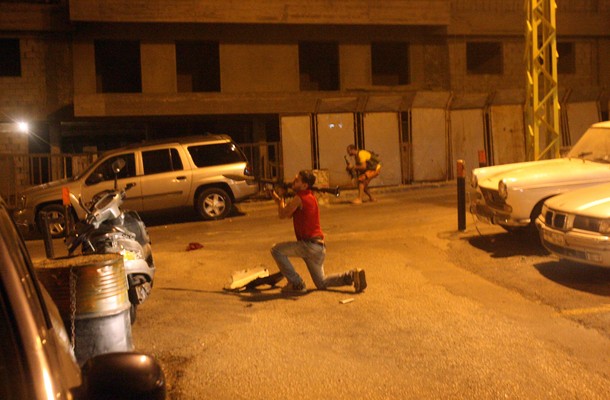
Hizballah fighters clashed with Ahbash (a Syrian-backed Sunni organization) fighters in the Abi Haidar neighborhood of Beirut on the night of August 24th, 2010, leaving one Hizballah official (Mohammad Fawaz, the Hizballah director for the neighborhood) and his bodyguard dead.  A 19 year old Kurdish resident of the neighborhood (described as an Ahbash fighter) along with another bystander were also killed (reportedly in a nearby neighborhood which got caught up in the fighting).  NOWLebanon has a good on the ground piece on the finding.

Meanwhile, speculation abounds as to the "significance" of the clash given the Ahbash's unilateral and superseding loyalty to the Syrian regime - and, of course, Hizballah's to Iran - and the feverish fervor and eagerness to fight displayed by both parties.

The clash comes in light of intense speculation and popular apprehension of upcoming Special Tribunal for Lebanon indictments rumored to be issued in December.  In recent weeks Hizballah has aggressively maneuvered to cast doubt on the Tribunal and the investigation into the Hariri assassination (as well as those that followed) and paint it as an international conspiracy contrived against the Iranian-outfitted group. 

Some images of the gunfight (via DayLife) and its after effects below:
Above: A Lebanese gunman takes position along Burj Abi Haidar Street in Beirut, late on August 24, 2010, during clashes between the Shiite movement Hezbollah and a Sunni Muslim group al-Ahbash (Getty Images). Second: Lebanon's Hezbollah gunmen walk at Burj Abi Haidar street in Beirut during clashes (Reuters Pictures).Third: Lebanese civil defense workers carry an injured man that was hit in the clashes that erupted (AP Photo). Bottom: Lebanese people flee the area of clashes in Beirut's Burj Abi Haidar neighbourhood on August 24, 2010 (Getty Images).

Wednesday, August 18, 2010

Hassan Fadlallah: R.I.P.

This is a bit delayed ... but below you'll find links to two of the better articles on Fadlallah I've found, looking at his past and commemorating his passing:

Tuesday, July 13, 2010

Hizballah: Enemy of the State

Tony Badran writes what is perhaps the most lucid interpretation and analysis of Hizballah's operational philosophy, in Lebanon and as an extension of Iran's regional policy. This piece should be read in full, below are some excerpts:
The recent tension in South Lebanon, choreographed by Hezbollah against UNIFIL under the guise of spontaneous protests by villagers, has been used by the party to reassert its equation of “the Resistance, the people, and the army”— the three mutually-reinforcing pillars which, Hezbollah maintains, are alone responsible for safeguarding the country’s security. The core premise of this mantra, however, has its origins in Iran’s Islamic revolutionary doctrine.
...
The absence of any reference to the “state” in this formula, and its substitution with the category of “people” is not accidental. ...
...
Dissociating the peoples from their governments in the Arab world was and remains a vital aim of the Iranian revolutionary regime. ...
...
That is the essence of Hezbollah’s formula. Much like the Iranian Revolutionary Guard Corps (IRGC), Hezbollah operates in a parallel universe; it forms a parallel military and presides over a parallel society, which “coordinate” with the armed forces and interact with the state only in order to neutralize the state’s ability to challenge the party’s autonomous, parallel existence. All of which of course makes a mockery of those in the West advocating dialogue with Hezbollah to encourage its further “integration” into the “political mainstream.”

As party official Mahmoud Qomati explained in 2009, Hezbollah seeks to integrate the state into “the axis of the army, the people, and the Resistance.” This of course merely echoed a central theme in the thinking of Hezbollah, articulated by the party’s deputy secretary general, Naim Qassem, in a June 2007 article in An-Nahar revealingly titled “How Does the Rest of Society Integrate into the Resistance?”
...