Sunday, August 29, 2010

Syria's Message: Us or Hizballah

Lebanese mourners walk past a portrait of the late founder of the Islamic republic in Iran, Ayatollah Ruhollah Khomeini, during the funeral of Hezbollah member Mohammed Fawaz in the village of Tibnin in southern Lebanon on August 26, 2010, two days after he and two other Lebanese men were killed in clashes in Beirut's Burj Abi Haidar district, between two pro-Syrian movements, the Shiite Muslim Hezbollah and the Sunni Muslim al-Ahbash group. (Getty Images via Daylife)

Hanin Ghaddar comments on the recent Hizballah-Ahbash clash in the Abi Haidar neighborhood of Beirut.  As always, the article is worth reading in full, excerpts below:
...
Thus, the clashes must be seen as a message from Syria to Hezbollah that Damascus is back and that the Party of God no longer single-handedly controls the political scene in Lebanon. It is also worth mentioning that this happened immediately after Iranian President Mahmoud Ahmadinejad declared that he would visit Lebanon on September 11 and 12.

Using a Sunni militia to deliver the message is interesting, as Syria might also be sending another message to the Saudis and Prime Minister Saad Hariri that it can protect the Lebanese Sunnis. As for the international community, Syria was clearly telling it that it can hurt Hezbollah, and that it should be given back Lebanon as a reward.

... The Lebanese in general and the Sunnis in particular are being given two options: Hezbollah’s control or the return of Syrian hegemony. This means that the Lebanese have to pay for the Syrian-Iranian alliance and for when this alliance weakens.

... The day after the clashes, Al-Ahbash officials went to Damascus to meet senior Syrian general and former head of Syrian intelligence in Lebanon Rustum Ghazali, a clear indication that Syria sponsors and controls Al-Ahbash. Of course, this does not mean that Syria and Iran are no longer allies. When Imad Mugniyah was assassinated in Damascus, ... many laid the blame on the Syrian regime, claiming Mugniyah had been killed to sever the tie linking Hezbollah to the Hariri assassination.
...
Related Posts:

Saturday, August 28, 2010

Basketball: Lebanon Defeats Canada

Lebanese player Fadi El Khatib (C) tries to shoot the ball in front Canada's Jevohn Shepherd (R) during the preliminary round game between Canada and Lebanon at the FIBA World Basketball Championships in Izmir, Turkey on August 28, 2010. (Getty Images via Daylife)

Horrid Abuse in Saudi Arabia

Its hard to believe that this - 24 nails driven into this mother of three's body - took place over a span of a month. One month! BBCNews reports:
Ms Ariyawathie, a mother of three, travelled to Saudi Arabia in March to become a housemaid.

Detail of an X-ray film showing nails in hand of Sri Lankan housemaid Doctors say this X-ray shows nails embedded in the housemaid's hand

Last week, she flew back to Sri Lanka and was admitted to hospital in the south of the island, where she told doctors she had undergone abuse for more than a month.

"When we checked her, we found 24 metal pieces in her legs and hands. She still can't properly sit down and walk," Dr Kamal Weerathunga told BBC Sandeshaya.
This case is truly tragic, reprehensible and deserving of investigation (at the very least) by the authorities in Saudi Arabia. Of course, this isn't the first time this has happened in the oil kingdom, and it likely won't be the last.

Friday, August 27, 2010

Leb Web Digest: 27.08.10

France Offered Lebanon 100 HOT Missiles

... a high level French official informed Asharq Al-Awsat that French Defense Minister Herve Morin had sent a letter to his Lebanese counterpart Elias Murr in May – via the French Army Chief of Staff who was visiting Lebanon at the time – informing him that Paris was "ready" to deliver 100 HOT missiles to Beirut.  The HOT [High Subsonic Optical Remote-Guided Fired from Tube] missiles is a long-range anti-tank missile system designed by Euromissile that Beirut want to arm its French-designed Gazelle army helicopters with. 

The French official acknowledged that Israel "protested" the French decision ... and that Washington raised "question marks" ... However he also "categorically denied" that Paris had "given in to pressure" and that this was behind the deal not being completed.

The senior French official placed the blame for this arms deal's failure or delay upon Lebanon, citing the state of "confusion" that the Lebanese administration is suffering from, especially with regards to defense affairs.

Thursday, August 26, 2010

Iran and Syria: Lebanon Tug of War

 
People check damages to their shops a day after street gun battles in Beirut's residential area of Bourj Abu Haidar, Lebanon, Wednesday, Aug. 25, 2010.(AP Photo via Day Life)

Michael Young spells it out in an editorial for the Daily Star, extensive quoting below:
You had to agree with the pro-Hizbullah daily Al-Akhbar when it observed in its Wednesday edition that one could only “naively” assume that the Burj Abi Haidar fighting the previous evening was the result of a personal dispute between supporters of Hizbullah and the Society of Islamic Philanthropic Projects, known as the Ahbash.

... most media outlets agreed that tension had been brewing in the neighborhood for some time. The Ahbash are close to Syria, not to say the Syrian intelligence services, which has long employed the group as a counterweight to Sunni militant groups the Syrian regime considers threatening, above all the Muslim Brotherhood. In the postwar period, the Syrians used the Ahbash against the Hariri family – indeed Ahbash members were suspected of involvement in the assassination of the former prime minister, Rafik Hariri – and to undercut the authority of the mufti and the Sunni religious establishment.

... Here was, perhaps, the first armed confrontation between Iran and Syria in Lebanon, through proxies, to determine who will dominate the country in the future. More specifically, the Syrians, in endeavoring to revive their hegemony, have entered into a struggle for power with the only force that can stand up to them locally, Hizbullah, on which Damascus seeks to impose its priorities. Not surprisingly, Hizbullah has refused to surrender the political gains it accumulated during the past five years – gains, above all, in the service of Iran.

The heart of the problem is the Special Tribunal for Lebanon. A decision is expected from the institution in the coming months – whether indictments or the identification of suspects. Hizbullah feels it will be targeted by such a step and has raised the heat on the government of Prime Minister Saad Hariri to immediately end Lebanon’s cooperation with the tribunal. Hariri has refused, and can afford to buy time. That’s because Hariri knows that Syria intends to use any tribunal decision as leverage over Hizbullah, to push the party to surrender to Damascus key posts it controls in the public administration and the security and military apparatus.

In light of this, Syria, like Hariri, is waiting for the tribunal to come out with something first, before opening negotiations with Hizbullah; while Hizbullah’s secretary general, Sayyed Hassan Nasrallah, keen to avoid any such bargaining, is out to create an intolerable situation on the ground so that Hariri is left with no choice but to scuttle the tribunal before its findings push the party into a corner.

Initially, Hizbullah felt that it had a range of options to intimidate Hariri. Party spokesmen ominously mentioned a return to May 2008, when Hizbullah and Amal overran western Beirut militarily and forced the government of Fouad Siniora to annul two decisions that the party regarded as threatening. Hizbullah officials also raised the possibility of bringing down the current government. However, at a summit in Beirut several weeks ago, President Michel Sleiman, King Abdullah of Saudi Arabia, and President Bashar Assad of Syria signed on to a statement that effectively ruled out both measures.
...
What will be interesting to watch in the coming weeks is what happens on the margins of the Syrian-Iranian struggle over Lebanon. The Parliament speaker, Nabih Berri, whose allegiances are with Syria, must yet be very careful of how he manages his relationship with Hizbullah. It was indicative of Berri’s dilemma that during the Burj Abi Haidar incident Amal issued a statement saying it was not involved, even as some of its men fought on Hizbullah’s side.

Walid Jumblatt is another politician who must play the Syria-Hizbullah rivalry very carefully. He has been especially vocal recently in calling for the tribunal to be abandoned. That’s because it only exacerbates the tensions between Damascus and Hizbullah, and Jumblatt and his community happen to be caught in the middle. The Druze leader has been the target of repeated condemnation in Al-Akhbar lately, principally because Hizbullah views him as particularly vulnerable (which Jumblatt is), and wants to keep him in line.

...What divides Syria and Iran is power, which is something neither is presently inclined to share in Beirut. Even if Hizbullah and Syria avoid episodes like the one on Tuesday, there will be other outbursts of violence or political altercations as the tribunal nears the time when it takes some sort of action.

Particularly revealing is the extent to which Hizbullah feels confident that it can out-maneuver Syria in Lebanon. Damascus was never very good at anchoring itself among the Lebanese without its army and intelligence services around to enforce its dictates. Ironically, Hizbullah has become the principle bulwark resisting a Syrian comeback, because the party wants to preserve Lebanon for Iran. What abysmal choices we Lebanese are left with.
 Related Posts:

Hizballah-Ahbash Clash in Beirut


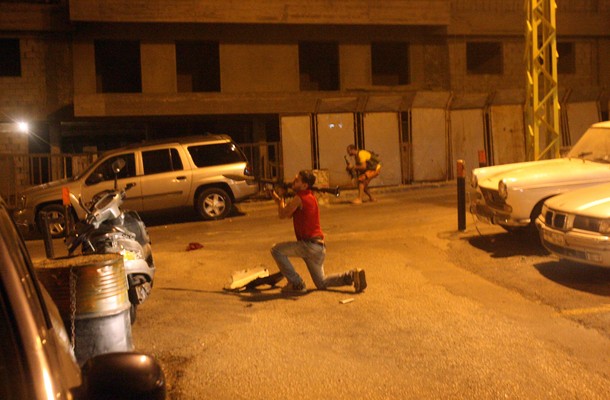
Hizballah fighters clashed with Ahbash (a Syrian-backed Sunni organization) fighters in the Abi Haidar neighborhood of Beirut on the night of August 24th, 2010, leaving one Hizballah official (Mohammad Fawaz, the Hizballah director for the neighborhood) and his bodyguard dead.  A 19 year old Kurdish resident of the neighborhood (described as an Ahbash fighter) along with another bystander were also killed (reportedly in a nearby neighborhood which got caught up in the fighting).  NOWLebanon has a good on the ground piece on the finding.

Meanwhile, speculation abounds as to the "significance" of the clash given the Ahbash's unilateral and superseding loyalty to the Syrian regime - and, of course, Hizballah's to Iran - and the feverish fervor and eagerness to fight displayed by both parties.

The clash comes in light of intense speculation and popular apprehension of upcoming Special Tribunal for Lebanon indictments rumored to be issued in December.  In recent weeks Hizballah has aggressively maneuvered to cast doubt on the Tribunal and the investigation into the Hariri assassination (as well as those that followed) and paint it as an international conspiracy contrived against the Iranian-outfitted group. 

Some images of the gunfight (via DayLife) and its after effects below:
Above: A Lebanese gunman takes position along Burj Abi Haidar Street in Beirut, late on August 24, 2010, during clashes between the Shiite movement Hezbollah and a Sunni Muslim group al-Ahbash (Getty Images). Second: Lebanon's Hezbollah gunmen walk at Burj Abi Haidar street in Beirut during clashes (Reuters Pictures).Third: Lebanese civil defense workers carry an injured man that was hit in the clashes that erupted (AP Photo). Bottom: Lebanese people flee the area of clashes in Beirut's Burj Abi Haidar neighbourhood on August 24, 2010 (Getty Images).

In Egypt: Two Megacities Rise out of the Desert

The New York Times reports:
...
Cairo has become so crowded, congested and polluted that the Egyptian government has undertaken a construction project that might have given the Pharaohs pause: building two megacities outside Cairo from scratch. By 2020, planners expect the new satellite cities to house at least a quarter of Cairo’s 20 million residents and many of the government agencies that now have headquarters in the city.

Only a country with a seemingly endless supply of open desert land — and an authoritarian government free to ignore public opinion — could contemplate such a gargantuan undertaking. The government already has moved a few thousand of the city’s poorest residents against their will from illegal slums in central Cairo to housing projects on the periphery.
...
Enormous subdivisions have sprung up in the dunes outside of Cairo, on an almost incomprehensible scale. Already a million people have moved to 6 October City, due west of Cairo, named for the date of the 1973 war between Egypt and Israel still hailed as a seminal Arab victory. A similar number have moved east of the city, to a settlement unimaginatively dubbed “New Cairo.”

The government’s original plans — which are widely considered more wishful than literal — conceived of 6 October City’s expanding to 3 million by 2020 and New Cairo to 4 million, primarily as havens for working-class Cairenes. So far, however, the overwhelming majority of new residents come from Egypt’s uppermost economic strata.
...
The Egyptian government has spent untallied millions of dollars building new roads and power and water lines to the desert areas it designated for future development. It has sold huge parcels of land to developers in opaque deals, and built some low-income housing. But it has relied primarily on private developers to put up the cities’ more expensive villas and condos, as well as the malls and offices.
...
Other pioneers include some of the richest Cairenes, who buy villas on golf courses and in gated compounds. They have been joined by some of the poorest, drawn by factory and construction jobs, or to serve the rich. Other poor people are shuttled in against their will by the government to isolated tracts of row houses.

The juxtaposition of rich and poor highlights one of Mr. Abdelhalim’s greatest concerns. ...

Consider Haram City, the first affordable housing development here built by a private company. Phase 1 was just completed this summer, and 25,000 people have moved in. When it is complete in two years, Haram City will house 400,000 people — a single project with the population of Miami.

Although it was designed for lower-income workers, some of Haram City’s first residents are indigent Cairenes who were displaced by a rockslide and moved to this distant development by the government. They complain that they are isolated, and that it costs them nearly as much to take the bus into the city as they can earn in a day’s work.
...
Haram City was conceived as an affordable neighborhood for lower-middle-class professionals, but the government has bought hundreds of units and is filling them with some of Cairo’s poorest inhabitants — importing the city’s historic class tensions to the replacement 6 October City.

Piecemeal development has created short-term hiccups as well. The new development lacks a subway, sufficient jobs, schools and medical services. Businesses, however, are relocating to the new city and the government plans to put many of its ministries and service buildings there.
...
A few miles farther out in the desert is the extreme side of replacement Cairo: an exclusive golf course community called Allegria, already half built, and the planned luxury development of Westown, flanking the main highway from Cairo to Alexandria. Developers are building a replica of downtown Beirut, which will serve as an urban hub for all the gated communities and other developments proliferating in the desert.
...

Wednesday, August 18, 2010

Hassan Fadlallah: R.I.P.

This is a bit delayed ... but below you'll find links to two of the better articles on Fadlallah I've found, looking at his past and commemorating his passing:

Tuesday, July 20, 2010

Reviewing Voting Methods

Quoted at length, an interesting piece (in the form of a book review) by the New Yorker on election methods. Take a deep breath:
The voting method that is used in Britain—and that has been kept on in some of its former colonies, including the United States—may finally be replaced. ... a national referendum on changing the country’s main voting system ... will be held in 2011. If Britain does switch, as most other developed countries already have, the cause of voting reform in holdouts like the United States, India, and Canada could get a boost.

["First Past the Post" or "Winner Takes All" ]

In the standard British style of voting, each elector casts one vote, and the candidate with more votes than any other is elected. This is known as “first past the post”; the winner just needs to get more votes than anyone else, not achieve any threshold (such as a two-thirds majority). It is also called “winner takes all,” to distinguish it from some other methods, which elect the top two or more candidates.

In a contest between two people for one job, first past the post seems to be merely common sense. But, as soon as there are three or more candidates on the slate, it can quickly go awry. ...

Add political parties to the picture, and the winner-take-all system looks even worse. A party’s share of seats in a parliament or a congress can diverge wildly from its over-all share of votes. ... In this year’s election, the Liberal Democrat Party won more than a fifth of the votes and less than a tenth of the seats. That’s because Lib-Dem supporters today ... are thinly scattered across the land.

In a country with just two political parties, winner takes all can deliver a proportionate parliament or congress. But that’s only because the supporters of political parties tend to live in clusters. Say that fifty-three per cent of American voters are Democrats and forty-six per cent are Republicans (mirroring the vote in last year’s Presidential election). Then imagine that the supporters of the two parties were spread evenly throughout the country’s districts ... In that case, the Democrats would win every seat and there would be no Republicans in Congress.

[Rank Voting and Two-Stage Votes]

... Jean-Charles de Borda, a French mathematician and a naval hero of the American Revolutionary War, ... Borda’s main suggestion was to require voters to rank candidates, rather than just choose one favorite, so that a winner could be calculated by counting points awarded according to the rankings. The key idea was to find a way of taking lower preferences, as well as first preferences, into account....

Unfortunately, this method may fail to elect the majority’s favorite—it could, in theory, elect someone who was nobody’s favorite. It is also easy to manipulate by strategic voting. ...

... [T]he astronomer and mathematician Pierre-Simon Laplace, who was an important contributor to the theory of probability ... insisted on an over-all majority: at least half the votes plus one. ... Elections to the French National Assembly, and to the French Presidency, currently borrow from both Laplace and Condorcet. They use a two-stage method that guarantees a winning candidate with an over-all majority, by conducting a runoff round between the top two candidates from the first round. ...

[Proportional Representation]

... Another early advocate of proportional representation was John Stuart Mill, who, in 1861, wrote about the critical distinction between “government of the whole people by the whole people, equally represented,” which was the ideal, and “government of the whole people by a mere majority of the people exclusively represented,” which is what winner-takes-all elections produce. ...

The key to proportional representation is to enlarge constituencies so that more than one winner is elected in each, and then try to align the share of seats won by a party with the share of votes it receives. These days, a few small countries, including Israel and the Netherlands, treat their entire populations as single constituencies, and thereby get almost perfectly proportional representation. Some places require a party to cross a certain threshold of votes before it gets any seats, in order to filter out extremists.

The main criticisms of proportional representation are that it can lead to unstable coalition governments, because more parties are successful in elections, and that it can weaken the local ties between electors and their representatives. ...

The alternative voting method that will be put to a referendum in Britain is not proportional representation ... Known in the United States as instant-runoff voting, the method was developed around 1870 by William Ware ...
...
[Instant Runoff]

In instant-runoff elections, voters rank all or some of the candidates in order of preference, and votes may be transferred between candidates. The idea is that your vote may count even if your favorite loses. If any candidate gets more than half of all the first-preference votes, he or she wins, and the game is over. But, if there is no majority winner, the candidate with the fewest first-preference votes is eliminated. Then the second-preference votes of his or her supporters are distributed to the other candidates. If there is still nobody with more than half the votes, another candidate is eliminated, and the process is repeated until either someone has a majority or there are only two candidates left, in which case the one with the most votes wins. Third, fourth, and lower preferences will be redistributed if a voter’s higher preferences have already been transferred to candidates who were eliminated earlier.

At first glance, this is an appealing approach: it is guaranteed to produce a clear winner, and more voters will have a say in the election’s outcome. Look more closely, though, and you start to see how peculiar the logic behind it is. Although more people’s votes contribute to the result, they do so in strange ways. Some people’s second, third, or even lower preferences count for as much as other people’s first preferences. If you back the loser of the first tally, then in the subsequent tallies your second (and maybe lower) preferences will be added to that candidate’s first preferences. ...

Such transferrable-vote elections can behave in topsy-turvy ways: they are what mathematicians call “non-monotonic,” which means that something can go up when it should go down, or vice versa. ... In short, a candidate may lose if certain voters back him, and would have won if they hadn’t.

... [R]ecent work by Robert Norman, a mathematician at Dartmouth, suggests [a topsy-turvy result] would happen in one in five close contests among three candidates who each have between twenty-five and forty per cent of first-preference votes. With larger numbers of candidates, it would happen even more often. ... Burlington’s ... 2009 mayoral elections ... did go topsy-turvy.

... Kenneth Arrow, an economist at Stanford, examined a set of requirements that you’d think any reasonable voting system could satisfy, and proved that nothing can meet them all when there are more than two candidates. So designing elections is always a matter of choosing a lesser evil. ...

[Grade Voting]

There is something of a loophole in Arrow’s demonstration. His proof applies only when voters rank candidates; it would not apply if, instead, they rated candidates by giving them grades. First-past-the-post voting is, in effect, a crude ranking method in which voters put one candidate in first place and everyone else last. Similarly, in the standard forms of proportional representation voters rank one party or group of candidates first, and all other parties and candidates last. With rating methods, on the other hand, voters would give all or some candidates a score, to say how much they like them. They would not have to say which is their favorite—though they could in effect do so, by giving only him or her their highest score—and they would not have to decide on an order of preference for the other candidates.

One such method is widely used on the Internet—to rate restaurants, movies, books, or other people’s comments or reviews, for example. ...

[Approval Voting]

Approval voting, as used in the last round of old Venetian elections, is a rating system with just two grades: approved and not approved. ... The American Mathematical Society and the Mathematical Association of America, among others, use it for internal elections, though the larger Institute of Electrical and Electronics Engineers, which also adopted it, came to have second thoughts.

Range and approval voting deal neatly with the problem of vote-splitting: if a voter likes Nader best, and would rather have Gore than Bush, he or she can approve Nader and Gore but not Bush. Above all, their advocates say, both schemes give voters more options, and would elect the candidate with the most over-all support, rather than the one preferred by the largest minority. Both can be modified to deliver forms of proportional representation.

The fact that they escape Arrow’s proof, though, doesn’t mean that approval and range voting have no hidden kinks or paradoxes. Whether such ideas can work depends on how people use them. If enough people are carelessly generous with their approval votes, for example, there could be some nasty surprises. ... Parties in an approval election might spend less time attacking their opponents, in order to pick up positive ratings from rivals’ supporters, and critics worry that it would favor bland politicians who don’t stand for anything much. ...

... Although almost any alternative voting scheme now on offer is likely to be better than first past the post, it’s unrealistic to think that one voting method would work equally well for, say, the legislature of a young African republic, the Presidency of an island in Oceania, the school board of a New England town, and the assembly of a country still scarred by civil war. If winner takes all is a poor electoral system, one size fits all is a poor way to pick its replacements....